China Book Reviews: Chinese Culture & Society
Educating Young Giants: What Kids Learn (And Don't Learn) in China and America

by Nancy Pine
Palgrave Macmillan, 2012
ISBN: 978-0-230-33907-1
193 pp
China is not satisfied with its education and is trying to become more like America. America is not satisfied with its education and is trying to become more like China. What is going on?
Both countries are trying to prepare their students for the future, a future in which, according to one Stanford professor of Education herein quoted, schools must "prepare students to work at jobs that do not yet exist, creating ideas and solutions for products and problems that have not yet been identified, using technologies that have not yet been invented." Author Nancy Pine takes a look at American and Chinese education systems, where they came from, and both where they are going and where they need to go.
China's education philosophy comes from Confucianism and heavily promotes rote memorization at the expense of creative thinking. American education has traditionally been more geared to creative thinking, but with the rise in dependence on standardized tests, this is changing.
A history teacher at a prestigious urban school in Guangzhou summarizes what his understanding of his job is. "I spend every minute of every class telling my high school students everything I know about history. Their job is to take notes and memorize the material."
Before Chinese and American children even reach school age, their educations are dissimilar. For example, Chinese children tend to be told how to correctly play with toys, while American children are often left on their own to figure out how to play with their toys.
Also discussed is "prewriting," which is what happens when two- and three-year-olds are asked to write. In China, children's "prewritings" are small with angular lines that can be likened to Chinese characters. American children "write" in big swirls and fill up much of the page, looking more like the English alphabet. Another idea Pine explores is the difference in the purpose of education. She quotes one Chinese observer of education as saying, "People in China see math and science as a tool to change their destiny, not to explore the world."
Of course, discipline in schools is discussed. In China, it is expected, demanded and just plain de rigueur. In America, discipline is - often a huge problem.
Any discussion of education in America must consider charter schools. Pine goes there, saying that American charter schools are successful basically because of their forward-thinking. School administrators in charter schools don't have to overcome central planning and the laser focus on preparing students for standardized tests.
Tests in both countries tend to measure what bits of information have been memorized. Tests of the future will also need to test thinking ability.
While readers might expect that a comparison of two countries' educational philosophies, which quotes a number of academics, by the way, might be prone to flatulent verbosity, this book actually is down to earth and easy to digest.
Pine doesn't try to offer many suggestions to improve America's education world, but when she does, at the end of the book, it can mostly be summed up as: let's spend lots more money.
If you are a reader who thinks copious notes and a long bibliography are important, you should know that there are 10 pages of notes and six pages of bibliography.
The book was published in 2012, so the reader might be left to wonder what has happened in Chinese and American education since then. Perhaps there is a more up-to-date book, but failing that there is still plenty to think about and mull over here in this book.
Marshall Hughes
Buy this book from Amazon USA | UK | Japan
Education in China: Philosophy, Politics and Culture

by Janette Ryan
Polity Press, 2019
ISBN: 978-0-7456-6410
208 pp
Like most things in China, the education system is going through major changes. Fierce battles are being fought over the direction of the future of education.
Author Janet Ryan's book, one of 27 books in a series of books called China Today, digs deep into the past, present and possible future of China's education.
The book is somewhat comparable to Educating Young Minds (see above review), but it is seven years newer, more analytical and more historical. Whereas Educating Young Minds is easy and fun to read, this book has you read through 50- and sometimes 75-word sentences. It is written for a more scholarly audience, so be prepared.
It starts with a good history and explanation of Chinese education, going back to the times of Confucius. In the early days, passing rigorous tests were seen as the path to the first-class life in China. Some 2,500 years later, this hasn't changed.
Education is the key to a comfortable life, and also a way for parents to lord their children's accomplishments over their neighbors. The tests are called gaokao, and they consume most children's lives. There are no participation trophies in Chinese education.
The lengths that some parents go to in order to get every possible advantage for their child can be stunning. Ryan tells of one student's parents from a Beijing high school who "paid for the entire teaching staff at the school to tour Europe over the summer." You can bet that they did not do this out of the kindness of their hearts. There is also a huge divide between rural and urban schools. In rural China, only half of students even attend high school, and only one-third of students finish high school.
China is pouring ever-increasing amounts of money into education. Between 2006 and 2016, the countries increased its education budget by 19% annually.
The fifth chapter is about competing ideologies in present day China. There are the hardcore Confucian traditionalists, neoliberals and the Communist Party all vying to control education. One of the reasons China is not moving ahead even faster is the corruption and cheating at all levels of education. Research is often faked or plagiarized, even at the highest levels of scientific papers.
"Changing Relationships with the World and Future Challenges" is the title of the last chapter, and here the author writes about China's expanding education role on the world scene. Not only is China sending more and more students abroad for college, but foreigners are starting to study in larger numbers in China. China wants its universities to be considered elite.
Ryan's conclusion is quite interesting. In part, she says, "The 'secret' to China's educational 'success' is not China's educational system, but the value placed on education in China, the high educational expectations and aspirations of students and parents, and the efforts and investments of individual families and students."
That sounds about right.
Marshall Hughes
Buy this book from Amazon USA | UK | Japan
Foreign Babes In Beijing
ISBN: 0393328597
389 pp
This an intriguing and entertaining story by Rachel DeWoskin who lived in Beijing as a 21-year-old American whose father was a Chinese cultural specialist. DeWoskin was working for a local PR firm while wanting to broaden her grip on Chinese language and her understanding of life in China. She accepted a role in a Chinese soap opera playing the part of a "foreign babe" who falls in love with a charming, good-looking, married Chinese man in a 20 episode drama aired to hundreds of millions of viewers across China.
DeWoskin's on-screen life and real life experiences often become intertwined to a point where they demonstrate huge cultural differences regarding expectations in relationships and daily life. DeWoskin manages to convey the confusion and illusions of a "foreign babe" trying to understand a China that has the motto "to get rich is glorious" as it rushes headlong towards modernization.
Set during the 1990s, there were bound to be conflicts ahead for DeWoskin who was "open minded" to learn more about China and its cultural customs, but she wasn't open minded in the way that Chinese people expected to her to be as a foreign babe, i.e. sexually free and easy to the point where she would take her clothes off in a taxi. She often felt more American in China than she did at home because of the way that she had to defend America.
DeWoskin helps the reader to understand that cultural conflicts are a normal part of life in China for an expat, there are conflicts but one has to work toward at least achieving an understanding so that 'harmony' can ensue. This is evidenced by the examples, she writes about her friends Kate and Anna in their relationships with newly found male Chinese friends. DeWoskin clearly misses the culture of her hometown New York but feels even more strongly about the cultural changes happening in Beijing. She writes of the loss of old Chinese customs to consumerism as people are seduced by products that they had never known or needed in the past but now pursue with blind vengeance. There is clearly a clash in DeWoskin's mind as she sees traditional Chinese culture challenged by liberated and economically driven values from the West supported by slogans like, "to get rich is glorious".
Reading a book like this can set the stage for some of the experiences and attitudes you could encounter as an expat living and working in China. DeWoskin found people wanting to be more like those of another culture, almost like cross cultural jealousies as she met Americans wanting to be more Chinese and Chinese wanting to be more American. The book is not a subjective account of life in Beijing, but certainly gives many ideas of the realities and flavors of life with a good dose of wit and insight throughout.
Buy this book from Amazon USA | UK | Japan
One Billion Customers: Lessons from the Front Lines of Doing Business in China

ISBN: 074325841X
355 pp
A must-read for entrepreneurs and CEO's wanting to do business in modern China. McGregor, a former Wall Street Journal journalist and head of the American Chamber of Commerce in Beijing, with over 15 years of experience in China, lays out the many failures and few successes of business people hoping to crack the Chinese market.
The author charts the history of China's rise to its present position as an Asian economic juggernaut and debunks many of the myths about the country held in the West. To understand the way the Chinese do business, you must understand something of the history and culture of the people. This of course seems obvious but McGregor details in depth why it is particularly so in the China context.
The book is structured around a series of case studies charting western business initiatives and joint-ventures in China: Morgan Stanley, Rupert Murdoch, Dow Jones, Boeing and China Unicom are a sample. Each chapter lists a "what this means for you" section and a useful "Little Red Book" at the end.
A well-researched book full of tips for good practice for those interested in working or doing business in China.
Buy this book from Amazon USA | UK | Japan
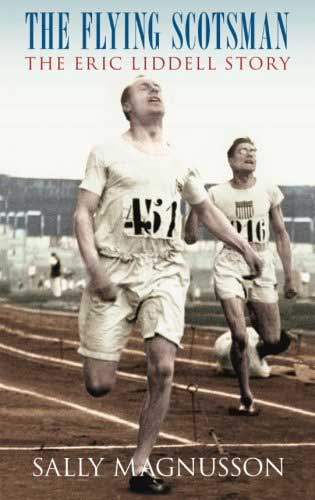
The Flying Scotsman: The Eric Liddell Story
The History Press, 2012
192 pp, paperback
ISBN: 978-0-7524-4352-2
When it comes to sports trivia, there is usually one agreed upon answer that is correct. However, to the question, "Who was the first Chinese medal winner at the Olympics, there are actually three possible answers.
The official sites of the Chinese government often list Xu Haifeng, a rifle shooter who won gold in the 1984 Los Angeles games, as China's first medal winner. Some Chinese consider Yang Chuanguang from Taiwan, who won silver in the 1960 Rome games as a decathlete, as the first.
The third answer is a man who was known, at least to some, by the name Li Airui.
Most people don't recognize that name, but many do know his real name, Eric Liddell, who was born and died in China, and thus considered China's first medal winner by some. Liddell was the subject of the 1981 Academy Award winning film, "Chariots of Fire."
As the world's fastest sprinter, Liddell, who was born to Christian missionaries in 1902 but who was educated exclusively in Scotland, was favored to win track and field's most celebrated event, the 100-meter dash, at the 1924 Paris Olympics. Although winning the 100 would not set him up financially for life, as it would today, a win would have assured a very bright future. There was one problem, however. The preliminary heats for the 100 were to be held on a Sunday, and Liddell considered Sundays to be The Lord's Day. Much to the dismay and criticism of some of his countrymen, he decided not to run, thereby forfeiting likely glory. The British press called him a traitor. He also passed on two relay races, which had heats on a Sunday. Instead, he ran in the 200, where he finished third, and the 400, an event in which he had very little experience. Running in the outside (worst) lane, he broke the world's 400 record in a stunning gold-medal performance.
Much of this in known because of "Chariots of Fire." It is the lesser-known parts of Liddell's life which make up the gist of this book. Barely a quarter of the way through the book, Liddell has won his medal and the book moves on to its main focus, what he did after his 1925 return to China.
He worked there as a teacher and missionary, until he and hundreds of others, were put in an internment camp by the Japanese during World War ll. Unable to get treatment for a brain tumor, he died there in 1945, just a few months before the war's conclusion. All told, he spent 26 of his 43 years living in China.
The book is filled with interesting historical details of the times from before his Olympic glory days in the 1920s through his dying days. The reader will come away with a better understanding of history, and not just sports history.
For all that he did for the Chinese people, he is fondly remembered there. In 1991, a stone memorial to Liddell was built in Weifang, at the site of the internment camp.
Of course, the Chinese would not let any mention of his Christian beliefs be on the monument, but on the back is written a well-known Bible verse, "They shall mount up with wings as eagles, they shall run and not be weary." The book offers interesting speculation as to whether Liddell could be a star in modern times. His life was never focused exclusively on his track career. He was a student and was very active in various Christian endeavors. He wasn't fully focused on becoming the world's fastest human.
At three or four points in the book the author describes details that the movie knowingly and purposely got wrong in their attempt to "improve" the story. The movie was British, showing that it is not only the American media which play fast and loose with facts if they think a few more bucks can be made.
Not only did Liddell lose his life because of his decision to return to China, he lost much more, too. For one thing, he never did get to see his third daughter, Maureen, because his pregnant wife and first two daughters left China in early 1941 when things started to get too dangerous.
Many pages are dedicated to the hope that Liddell gave those interred. His life went from working with the Chinese to encouraging the imprisoned foreigners. Many firsthand tributes are recorded in the book.
The only negative of the book is the exceptionally small type size used in this edition. If you have good eyes and read in a well-lit place, you might be OK.
All in all, this is a very worthwhile book.
Marshall Hughes
Buy this book from Amazon USA | UK | Japan