Xian Attractions 西安
Xi'an (the ancient capital city of Chang'an) is one of China's most interesting cities, with much to see and do for the visitor.
Xian's attractions include its preserved city walls and gates, the Bell and Drum Towers, the Great Mosque and surrounding Muslim Quarter, the Shaanxi History Museum and two impressive pagodas: the Big Wild Goose Pagoda and the Small Wild Goose Pagoda.
Xian's most famous attraction, though, is without doubt the amazing Terracotta Army and Tomb of Qin Shi Huang 28 km outside the city. Also not to be missed is the Tao Temple of Louguantai and the Qinling Mountains, about an hour's drive from the city.
Also find information on the weather in Xian and domestic flights to Xian from other cities in China.

Terracotta Army
Only discovered in 1974 when peasant workers were digging a well, the Terracotta Army, 28 km west of Xian, is one of the wonders of the ancient world.
In 221 B.C., Ying Zheng (259-210 B.C.), King of Qin, became the First Emperor of Qin, (Qin Shihuangdi), when he managed to consolidate the neighboring states under his rule. He had begun work on his tomb shortly after becoming king of Qin at the age of 13, and the work took a staggering 39 years to complete by an estimated 700,000 strong workforce.
The Terracotta Warriors on display in their museum today, represent only a small portion of the 8000-strong underground army buried in front of the Emperor Qinshihuang's tomb to defend him in the afterlife.
The craftsmanship of each clay warrior is as impressive as the scale of the project. Great care was taken to make each model unique, and each of the 8,000 soldiers had their own facial features, hair-style, and when dressed in the same uniform, the folds and fit are also unique. Located a mile west of the Terracotta Warrior Museum, Qin Shihuang's mausoleum is larger than Egypt's Great Pyramid, and has still not been fully excavated.
The vast tomb complex also contained the tombs of 48 concubines who were buried alive on the emperor's death along with the workers so the location of the necropolis would not be known. The floor reputedly had rivers of flowing mercury and the roof was studded with pearls to represent stars in the night sky.

Bell Tower
Xian's Bell Tower is the city's most recognizable building. Situated at the crossroads of the old town's four main roads - Xi Dajie (West Main Street), Dong Dajie (East Main Street), Bei Dajie (North Main Street) and Nan Dajie (South Main Street) - the Bell Tower is the very heart of Xian's ancient city.
The wooden Bell Tower dates from 1384 and was moved to its present location from two blocks west in 1582. Restored in 1739, the structure now sits on a brick base at the center of a traffic circle and is reached by underground passage.

Drum Tower
Xian's Drum Tower dates from 1380 and together with the Bell Tower sounded the beginning and end of each day. The bell was rung at dawn and the drum was beaten at dusk. The drums would also beat out in times of emergency.
The wooden Drum Tower stands on a 50 meter long brick arch and is 111 meters high. The building is situated a short stroll to the north west of the Bell Tower.
The Drum Tower was renovated twice during the Qing Dynasty (1644-1911) in 1699 and 1740. No iron nails were used in its construction.
Xian City Walls
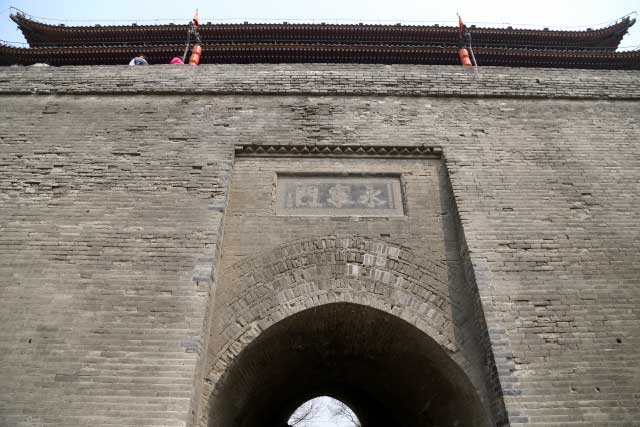
Xian's impressive city walls, which are around 12 meters high and 14 km in length, were first begun in 1370 during the reign of the first Ming Emperor - Hongwu (Zhu Yuanzhang).
Originally constructed from rammed earth, quicklime and glutinous rice resin, the walls were lined with brick in 1568.
The impressive walls are 18 meters thick at the base, topped with crenellations and ramparts, with watchtowers at each corner and a main gate on each side: Anyuan on the north side, Changlemen on the east, Yongning on the south and Andingmen on the west side.
The walls remain as one of the most ancient city defence systems in the world and visitors can stroll or cycle along the flat tops of the walls. Touring the city walls is one of the best ways to explore the city of Xian.
Big Wild Goose Pagoda
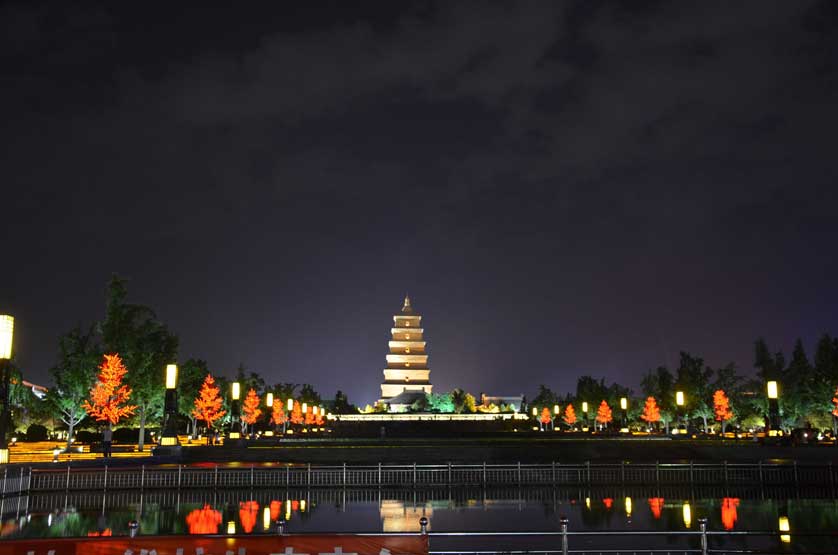
Xian's Big Wild Goose Pagoda was built in memory of the Gaozong Emperor's mother, Empress Wende on the grounds of the Ci'en Si Temple.
The temple is associated with the Chinese Buddhist monk Xuanzang (602-664), who traveled to India and brought back to China a number of Buddhist sutras and statues.
The Big Wild Goose Pagoda houses the scriptures, sutras and texts the monk collected on his travels in the Buddhist holy land.

Small Wild Goose Pagoda
Xian's Small Wild Goose Pagoda was built in the Tang Dynasty between 707-709 on the grounds of the Jianfu Si Temple. The original temple was built to honor the Emperor Gao Zong.
The temple stores Buddhist sutras and scriptures brought from India to Xian on the Silk Road by the pilgrim Yiqing to be translated here. The brick used in the construction of the pagoda was a protection against fire.
The pagoda is smaller than the Big Wild Goose Pagoda and the damage to the top of the pagoda caused by an earthquake in 1556 is still clearly visible, especially if you pay to ascend to the top via the narrow wooden stairs for a close-up view.
Originally, the pagoda had 15 storeys and stood 45 meters in height. Xi'an lies in an earthquake-prone area and the pagoda has survived a number of earthquakes. The circular base of packed stress is believed to be a design features to spread the force of the tremor.
The pagoda is now set in a pleasant, small park, southeast of the South East City Gate.
Great Mosque
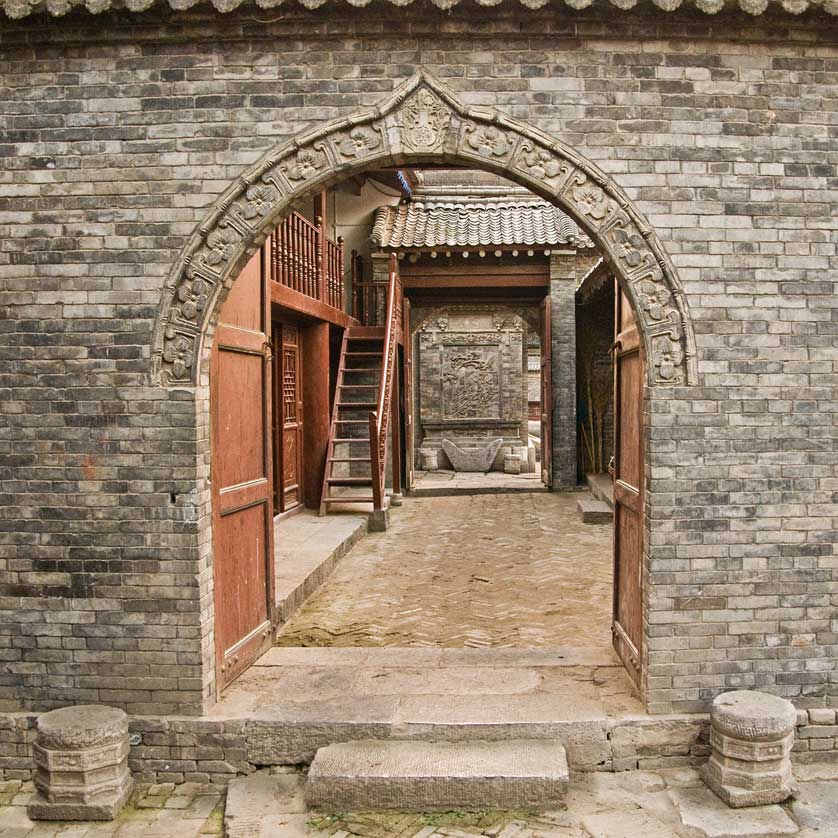
Xian's Great Mosque located in the Muslim Quarter of the city, a short way north west of the Bell Tower, is one of China's oldest and largest mosques.
The Great Mosque faces west (towards Mecca) and is a distinct blend of Islamic and Chinese architectural features. The spirit wall and gardens are plainly Chinese in inspiration and the mosque's 'Inspection Minaret' resembles a Chinese pagoda.
The original mosque was first built in 742 but has been restored during the Ming and Qing Dynasties. The mosque has four lovely courtyards and a prayer hall (closed to non-Muslims) with turquoise roof tiles. Inscriptions on the buildings are done in Arabic, Persian and Chinese.

Muslim Quarter
Xian's Muslim Quarter, north of the Drum Tower, is home to around 30,000 people of the city's Hui (Chinese Muslim) population.
The narrow, twisting streets are full of butcher's shops, restaurants, food stalls, sesame-oil factories, souvenir shops and tea shops. The area is a great place to stroll day or night to shop or soak up the unique atmosphere of this historic area. The Beiyuanmen Muslim Market is the main shopping street in the area.
Shaanxi History Museum
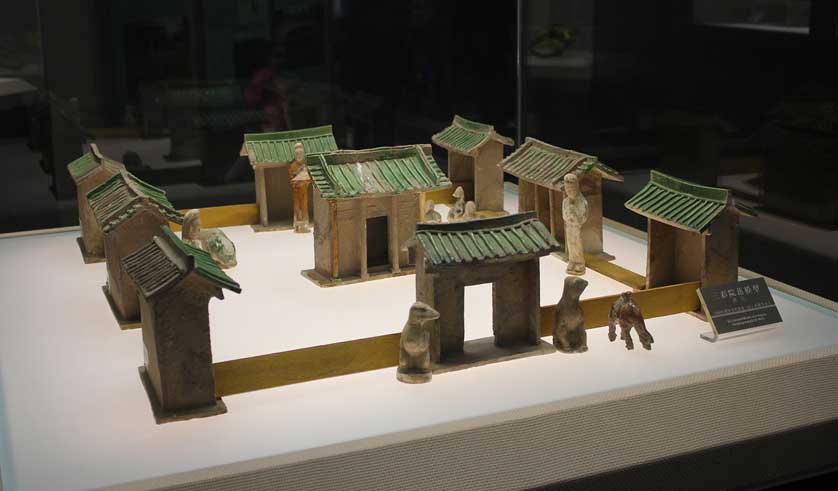
Xian's impressive Shaanxi History Museum contains over 370,000 exhibits ranging from Paleolithic stone tools to a beautiful jade seal of the Western Han Dynasty.
The ground floor of the two-storey building is dedicated to Chinese pre-history and the early dynasties: bronze tripods, the bronze Shang cooking pot and four of the original terracotta warrior statues are highlights among the ceramics, weapons and ornaments on this floor.
The second floor has Han to Qing Dynasty artifacts: figurines such as the Tang Sancai Horse, the Golden Monster figure of a charging beast, funerary objects and a beautiful agate ox-head drinking cup.
Louguantai Shan
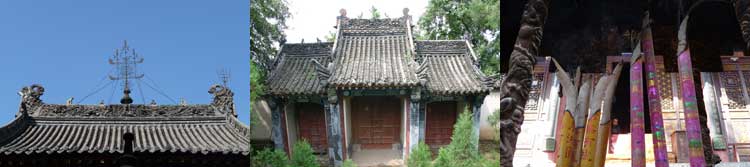
The remote mountains of Louguantai Shan, about a hour's drive south west of Xian, are known as an important place in the development of Taoism (Daoism) and more recently as a wildlife reserve for giant pandas and other endangered animals.
Rare animals known to inhabit the mountains include black bears, the crested ibis, giant salamanders, leopards, monkeys, musk deer, and the white lipped deer.
Legend has it, that it was in this area that the great sage Lao Tzu completed his classic Tao Te Ching in the 6th century BC and gave lectures on his work before leaving China on his journey westwards to an unknown destination.
The scenic hills around the Louguantai Taoist Temple are heavily forested with pine, oak, juniper and bamboo and the area is crossed by a number of fast-flowing mountain streams. Taoism stresses longevity, humility, non-action (wu wei), and reverence for nature. It is easy to see in the natural surroundings of Louguantai what may have drawn Lao Tzu to the area, on his spiritual search for truth, thousands of years ago.