Tianjin Guide 天津
Northern Neighbour: Tianjin emerges from Beijing's shadow 天津
Daniel Allen

Tianjin - also known by the Chinese as the "Shanghai of the North" - has a venerable and colorful history, but a proximity to Beijing means it has long played second fiddle to its larger neighbor in the tourist stakes.
Recent and ongoing investment in infrastructure and tourist attractions, however, coupled with its prominent role in hosting the 2008 Olympics, mean this city by the sea is proving increasingly popular for day trips and long weekend breaks, both with overseas visitors and Beijingers.
Tianjin History
Situated on China's northeastern coast about 150 kilometers east of Beijing, Tianjin sits close to Bohai Bay, an inlet of the Yellow Sea, at the intersection of two rivers and the Grand Canal. In line with its current position as northern China's largest industrial area and port, Tianjin's connection with trade dates back to the Yuan Dynasty (1271-1368), when it became a major center for shipping and grain storage.
Four centuries later, after the Second Opium War in 1860, the Treaties of Tianjin led to the creation of an array of foreign concessions in the city. Burgeoning trade and investment from the so-called "Western Powers" drove a building boom that has left Tianjin with some of the finest European-style buildings in China. For anyone interested in China's 20th century history and colonial architecture, the shady, mansion-lined streets around Jiefang North and Wudadao Streets are a treasure trove of discovery.
Fondly described by Beijingers as the "commonest city in China", Tianjin is certainly packed with simple pastimes and pleasures. Locals proudly declare that while the best-looking women in Guangzhou are those in limousines, the most beautiful Tianjin girls are those sitting on the back seats of their boyfriends' bicycles. Life is certainly a little slower here than in the capital, and, despite impressive development, the emphasis is still more on enjoyment than economic gain.
Despite this laissez-faire attitude, however, residents of Tianjin are not people to dwell on the past. Since Tianjin became a special economic development zone in the early 90s, foreign and domestic money has poured in to the municipality, and many old buildings have been sacrificed in the name of progress.
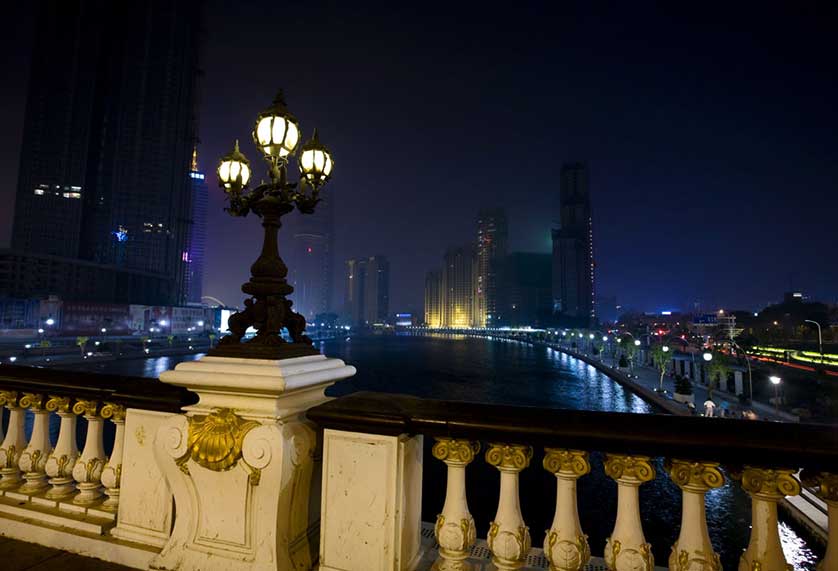

Tianjin Attractions
Two high-profile examples of this progress are the recently completed RMB 14.3 billion (US$ 2 billion) Beijing-Tianjin high speed rail service, and a gigantic ferris wheel known as the Tianjin Eye. Operational in time for the Olympics, the new bullet train whisks passengers between the two cities at a record-breaking 350 kilometers per hour, slashing travel time to just 30 minutes. The Tianjin Eye, an outsized version of its London cousin, offers fantastic views over the city as it spins sedately on its bridge-bound axis.
While a soaring skyline points to Tianjin's future, most of the city's attractions are rooted in history. Originally built more than 800 years ago in the Song Dynasty, Ancient Culture Street (Gu Wenhua Jie) is a fascinating collection of streets featuring Qing-style architecture in a traditional Tianjin style.
Culture Street shops, made from delicately carved bricks and decorated with intricate watercolors, are great for souvenir hunting, selling everything from fine artworks and handicraft tools to calligraphy brushes and kites. After a spot of retail therapy, shoppers can relax in a local teahouse to the sounds of Beijing opera and cross-talk (a form of comic dialogue known as xiangsheng in Chinese). The Hai River Park (Hai He Gongyuan) is also a good place to take in some impromptu, early morning operatic performances.
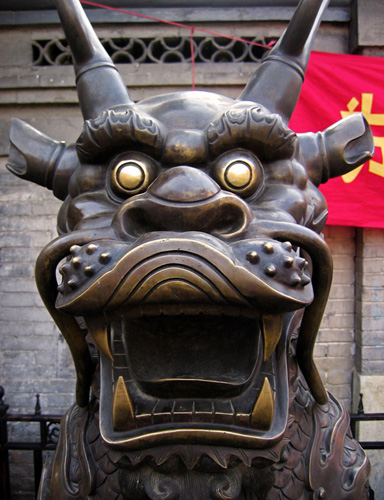
Close to Culture Street is Tianhou Temple (Tianhou Gong), which dates back to 1326 and contains an interesting museum of local customs. This was where local fishermen came to worship Mazu, Goddess of the Sea, and annual performances are held every year in front of the temple to celebrate her birthday. Other interesting places of worship in Tianjin include the Confucius Temple (Wen Miao), Great Mosque (Qingzhen Si), Dabei Monastery (Dabeiyuan), and the Catholic Church (Xikai Jiaotong).

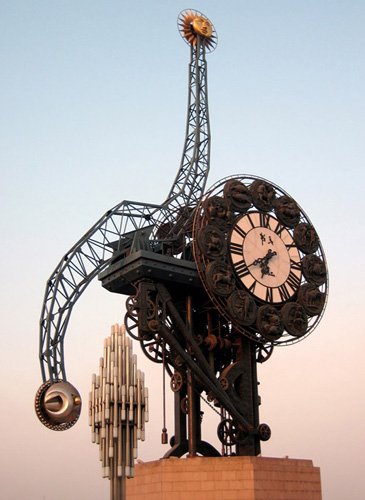
Tianjin Antique Market
Tianjin Antique Market (Guwan Shichang), one of China's most impressive markets, is also well worth a visit, especially on Sunday mornings. This bustling bazaar is located in the centre of the city, spread out over a network of streets, and offers a wide selection of ageing bric-a-brac, including stamps, coins, jewelry, snuff boxes, teapots and Chairman Mao memorabilia. Bargaining here is essential.
Tianjin residents are proud of their culinary heritage; dishes from all the major Chinese schools of cooking can be found in the city's restaurants, with fresh seafood especially delicious. Legend has it that Emperor Qianlong, the fourth emperor of the Qing Dynasty (1644-1911) who ruled from Beijing, enjoyed Tianjin food so much that he once awarded his yellow jacket, a symbol of honor, to his chef and appointed him a minor official.
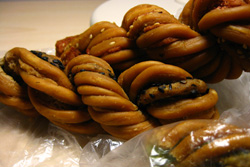


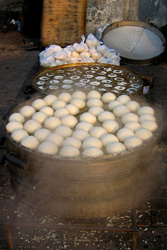
Food streets, such as those at Nanshi (southern city) are packed with stalls and eateries offering everything from crab and cuttlefish to pigeon, cured meat and pastries, as well as a range of international cuisine. The Heping District Food Street offers a more pan-Chinese dining experience, with flavors and recipes from all over China brought together in one mouthwatering locale.
Tianjin's unique snacks include fried dough twists (mahua), erduoyan fried cakes (fried cakes that look like an ear), goubuli baozi , thin pancakes, rice crusts and chestnuts roasted in sand with brown sugar. Goubuli baozi were a particular favorite of the Dowager Empress Cixi of the Qing Dynasty (1644-1911) - roughly translated goubuli means "stuffed bun that dogs are not interested in", a joke on the snack's inventor who was once too busy to talk to his long line of customers.

Tianjin Essentials - Getting To Tianjin
- Tianjin Binhai International Airport is 15 kilometers east from central Tianjin and connects the city with many other Chinese cities including Hangzhou, Harbin, Hong Kong, Shanghai, Wuhan, Xiamen and Xian, as well as the international destinations of Nagoya, Kuala Lumpur, Singapore and Seoul. Check elong.com for cheap flights.
- Regular high speed trains to Tianjin Station leave throughout the day from Beijing South station and take around 30 minutes. Tickets are RMB 58 for economy / RMB 69 for business.
- In Tianjin the metro, bus service and taxis (minimum fare RMB 8) are all cheap. Avoid non-metered taxis and taxis by the train station.
- Regular ferries run between Tianjin and Dalian (China), Incheon (South Korea) and Kobe (Japan).
Tianjin Metro
Tianjin Metro (Tianjin Rail Transit) was the second subway network to open in mainland China after Beijing. The first line, Line 1, began operating in 1984.
Nowadays the system covers just over 233 km, has 6 lines and 159 stations. Two companies operate the trains - Tianjin Metro (4 lines - 1, 2, 3 & 6) and Binhai Mass Transit Development Co (2 lines - 5 & 9).
The TEDA Modern Guided Rail Tram also runs in the city.
Line 1 (color-coded red) is 42 km long and links Donggulu with Liuyuan from the north east of the city to the south east.
Line 2 (yellow) runs roughly east-west and connects Caozhuang with Binhaiguojijichang. Intersection stations are Xinanjiao (Line 1), Changhong Gongyuan (Line 6) and Tianjin Station (Lines 3 & 9).
Line 3 (blue) links Xiaodian Station and Nanzhan.
Line 5 (orange) runs from Beichenkejiyuanbei to Zhongyiyifuyuan on nearly 35 km of track. Line 5 connects with Line 1 at Xiawafang Station and Line 6 at Zhongliuyiyuan.
Line 6 (purple) links Nansunzhuang with Meilinlu and opened in 2016. It has 42.6 km of track and 38 stations.
Line 9 (dark blue) is the longest line at over 50 km and connects Tianjinzhan (Tianjin Station) with Donghailu. Tianjin Station is an intersection station for lines 2, 3 and 9. Line 9 connects with Line 6 at Hongqinanlu.

Tianjin Accommodation
Book hotels in Tianjin
Nikko Hotel Tianjin
There are several hotels close to Tianjin Station including the Radisson Tianjin, the Atour Hotel Tianjin Railway Station Jinwan Square and the Tianjin Jinma Hotel.
See a full listing of over 600 hotels in Tianjin.

Book Hotel Accommodation in Beijing China
Book Hotels in Beijing - Booking.com
Find Hotels in Beijing - Agoda
Search Hotels in China - Booking.com
Recommended Hotels in Shanghai China - Agoda
Budget Hotels in Beijing - Booking.com
Best Hotels in Sanlitun - Booking.com
Book Luxury Hotels in Beijing
Beijing Palace Museum Ticket (The Forbidden City)
Mutianyu Great Wall Ticket & Cable Car
Guide Books on Beijing & China