Qingdao German Architecture
Qingdao's Shinan District: Vintage German Architecture by the Yellow Sea 青岛
Johannes Schonherr

Qingdao's most widely known product internationally is, no doubt, Tsingtao beer. Tsingtao being an alternative spelling for the city of Qingdao in Shandong Province.
Today, Tsingtao beer is sold world-wide and internationally regarded as the Chinese beer.
Unsurprisingly, the history of Tsingtao beer has been closely connected to the history of Qingdao city.
Namely to the period when Qingdao was a German colony (1898-1914), the time in which the brewery was founded (in 1903 to be exact).
As tasty as Tsingtao beer is, and yes, locally in Qingdao a variety of Tsingtao beers is available which easily beat the international versions of Tsingtao in terms of flavor, the period of German colonization left a legacy much larger than the suds.
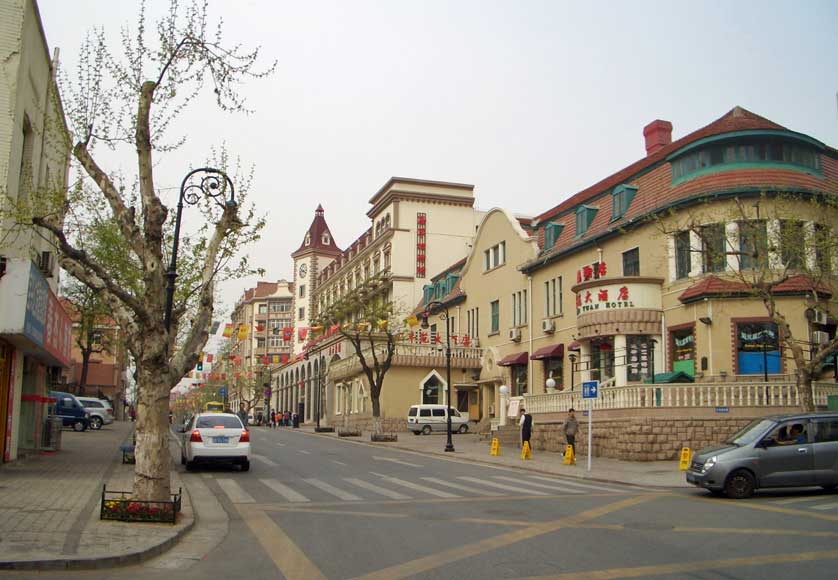
The historic district of Shinan is still dotted with German architecture from the earliest part of the 20th century. It makes for quite an unusual sight: buildings of a type and style you would expect to see in a mid-size Bavarian or Saxon town are in Qingdao part of modern Chinese daily life.
Many of those buildings might be plastered with signs in Chinese - their origin is unmistakably German however.


German Colonies
Germany arrived late as a colonial power at the end of the 19th century. By then, most Spanish colonies in South and Central America had already become independent states. Britain, France and Portugal however still had a strong grip on their properties spanning the world.
Germany made a dash in the 1880's and 90's and took over Cameroon, Togo, Tanzania and Southwest Africa (today's Namibia).
In the Pacific area, Germany occupied parts of today's Papua New Guinea, also Micronesia, the Marshall Islands, Nauru, the Marianas, Samoa - and a small territory in China.
The German colony in China, known as the Kiatschou Bay Concession, was located around Jiaozhou Bay on the south-western shore of the Shandong Peninsula in today's Shandong Province.
Using as pretext the murder of two German missionaries in 1897, three ships of the German navy landed in Jiaozhou Bay, a great natural harbor.
Subsequently, in similar fashion to the British acquisition of the Hong Kong New Territories, Germany squeezed a 99 year rental contract out of the weak Qing Dynasty in 1898.

Qingdao as a German Colonial Town
Right after Germany had secured the territory of Kiatschou, the tiny harbor town of Qingdao, spelled Tsingtau by the Germans, received highest priority.
Scores of German engineers and architects were sent in to turn the new property into a model colony.
A port large enough to accommodate ocean liners as well as warships was constructed, a railway line to connect Tsingtau with the already existing Chinese Railway system was forced through. Resistance by Chinese villagers was broken up by German troops.
Tiny Qingdao town was replaced by a German-style city with wide streets lined with German-style buildings. The whole city was thoroughly electrified, safe drinking tap water was provided, a rarity in Asia.
It all happened very quickly. By 1904, it was possible to travel by train from Germany to Tsingtau Station in a mere 12 to 14 days via the Trans-Siberian Railway, crossing Russia and north-east China.
The rail connection was much faster than travel by boat. Though troops could not be moved that way, colonial administrators and business people clearly preferred the train.
With a functioning railway connection to Germany in place, Tsingtau developed rapidly.
Tsingtau had at the time the highest per capita school enrollment in all of China, the economy boomed.
After the Chinese Revolution in 1911, new Chinese president Sun Yat-sen visited Tsingtau. He is said to have said: "I am impressed. The city is a true model for China's future."
The German presence in Tsingtau came to end when Japan sided with Britain in World War I and seized the territory in November 1914. Japan kept the area until international pressure forced Japan to return Qingdao to China in December 1922.
However, both during the Japanese occupation and the following years of Chinese rule, city development plans previously drawn up by German architects and engineers were implemented.

Shinan District
Today, urban Qingdao has a population of close to 6 million, counting the suburbs, it's more like 9 million people.
Only a tiny part of this modern sprawling metropolis is made up of the former German colonial city of Tsingtau.
The old German Tsingtau was located in the area today administrated as the Shinan District of Qingdao.
While the whole of Shinan District can be described as Qingdao's downtown, it's the western part of Shinan where you find the most colonial buildings.
That part of Shinan District is located on a small peninsula bordering the eastern side of the strait separating the Yellow Sea from Jiaozhou Bay.
Unlike today's Qingdao, old Tsingtau was a rather small town. Visitors can easily explore the area on foot.


Qingdao Station
Arriving in Qingdao in style would mean to arrive by train at Qingdao Station.
From Beijing, take a Beijing - Shanghai High Speed Railway train to Jinan, change there to the Jiaozhou - Jinan High Speed Railway.
Qingdao Station is the terminus of the line which still follows the old German-built train track constructed in 1904.
Originally built in 1901, Qingdao Station is a fine example of historic German train station architecture adjusted to modern use.
It underwent significant renovation in the years leading up the 2008 Beijing Olympic Games and today includes also a stop of Line 3 of the Qingdao Metro.
Former Qingdao Station Hotel
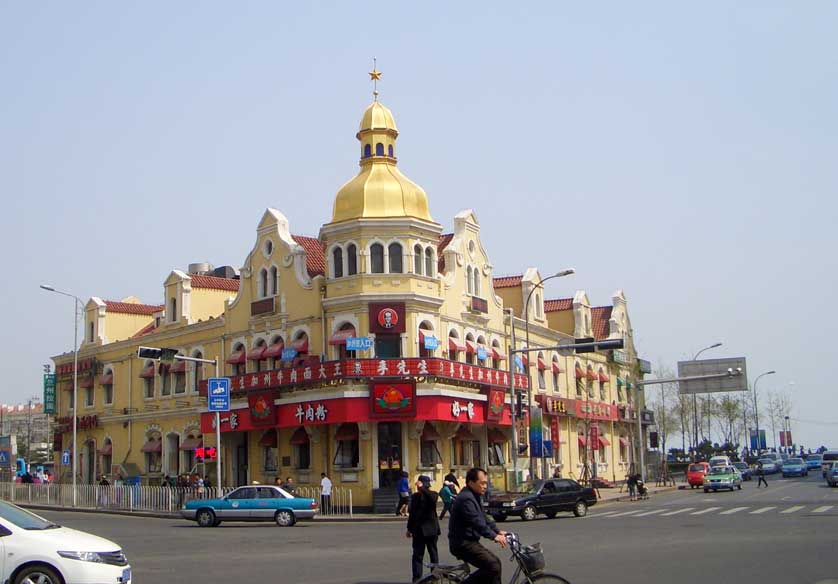
Just across the street from the main exit of Qingdao Station you can spot a bright yellow vintage building with a golden tower and a second-floor balcony.
That's the former Qingdao (Tsingtau) Station Hotel. When it opened in 1910, the hotel was Tsingtau's best and most luxurious hotel, offering its guests great comforts after their lengthy train ride from Berlin or Munich through the Russian and Mongolian steppes all the way to Qingdao / Tsingtau.
Today, the building houses a restaurant specializing in beef dishes, especially beef noodle soups.
At a visit to Qingdao in 2010, I stayed at the Richmoon Business Hotel, covering a portion of the old Qingdao Station Hotel.
The Richmoon Business Hotel offered clean modern rooms for very reasonable prices.
Some of those rooms bordered on the luxurious (still, very reasonable prices).
The Richmoon Business Hotel seems to have closed. Current Qingdao hotel guides do not list any hotel in this location, phone calls were answered by a machine saying that "this call cannot be completed as dialed."
Which is a shame. But who knows, perhaps the old Richmoon is just being refurbished into the sort of grand hotel the location actually deserves.
When planning a trip to Qingdao, you just might want to look for a hotel on 28 Lanshan Lu (Lanshan Road) in Shinan District. That's the address of the old Richmoon Business Hotel.
Staying there would put you right into the center of the old colonial neighborhood - in an original old colonial building.

Yellow Sea Waterfront / Huilan Pavilion
It is only about a three minute walk from the old Qingdao Station Hotel to the Yellow Sea waterfront.
The most iconic view there is Huilan Pavilion, a 2-story pagoda-style pavilion on a tiny artificial island in the sea. The 440 meter long Zhanqiao Pier provides a walkway to the pavilion.
In fact, Zhanqiao Pier was built first, in 1892, serving as a military dock for the Qing China Imperial Navy. Huilan Pavilion was added in 1930.
The pavilion might seem oddly familiar when you first spot it. That's because an artistic rendering of Huilan Pavilion can be seen on the label of every Tsingtao Beer bottle.
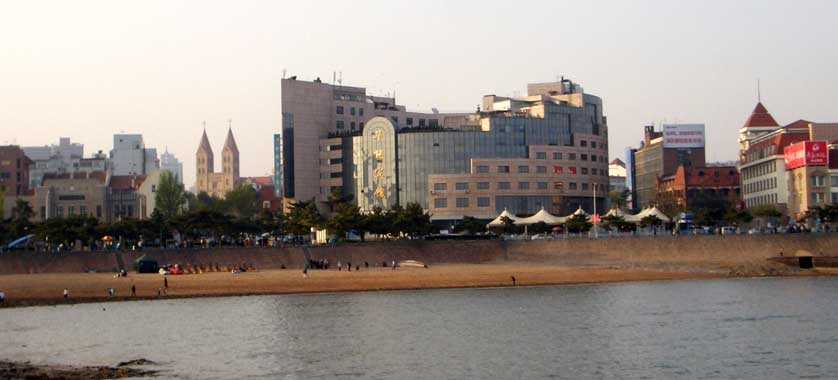
The waterfront itself provides a popular sandy beach and, behind a coastal road, a mix of modern Chinese and refurbished German-style buildings.
St. Michael's Cathedral
From Huilan Pavilion, St. Michel's Cathedral is clearly visible standing on top of a small hill in the center of the old German neighborhood.
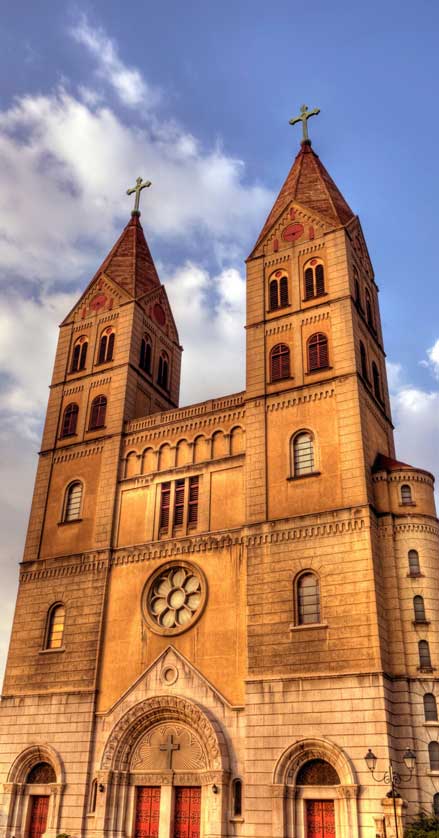
St. Michael's Cathedral is Qingdao's main Catholic church and one of the city's major landmarks.
The current church building, replacing a colonial era structure erected in 1902, dates back to 1934. Though Qingdao ceased to be a German colony in 1914, German Catholic missionaries continued to keep strong ties to the city and finally succeeded with their design.
The cathedral is architecturally modeled on historic German churches and today particularly attractive for western-style wedding ceremonies among Chinese couples.
Often, large numbers of newly-wed couples can be seen posing for wedding pictures in front of the cathedral.
St. Michael's Neighborhood
Strolling around the vicinity of the church and its wider environs, you find plenty of grand old German period buildings along the main streets.
The local post office, for example, is housed in a German era building. With its original interior largely intact, sending a postcard off from the post office feels like queueing up in an East German post office circa 1980.
Many other German era buildings in the neighborhood house today administrative and corporate offices. Most of them have been well restored.
Some of the streets feature long rows of German era buildings - walking along feels like strolling through a well-kept section of early 20th century architecture in a German town.
Just that all the signs are in Chinese, most pedestrians are Chinese and the cars have Shandong Province license plates.
Enter the small lanes behind the grand old buildings, though, and you soon arrive at narrow alleys with busy Chinese food markets. The emphasis here is on seafood. Shellfish of all kinds, shrimps of all sizes, crabs, dried starfish. Qingdao is famous for this type of seafood.
Many restaurants in the area serve a large variety of seafood. English-language menus are often but not always available.
When not, staff will try their best to find an interpreter - they may even pluck a student out of a partying group at a nearby table and ask him or her to translate for you.
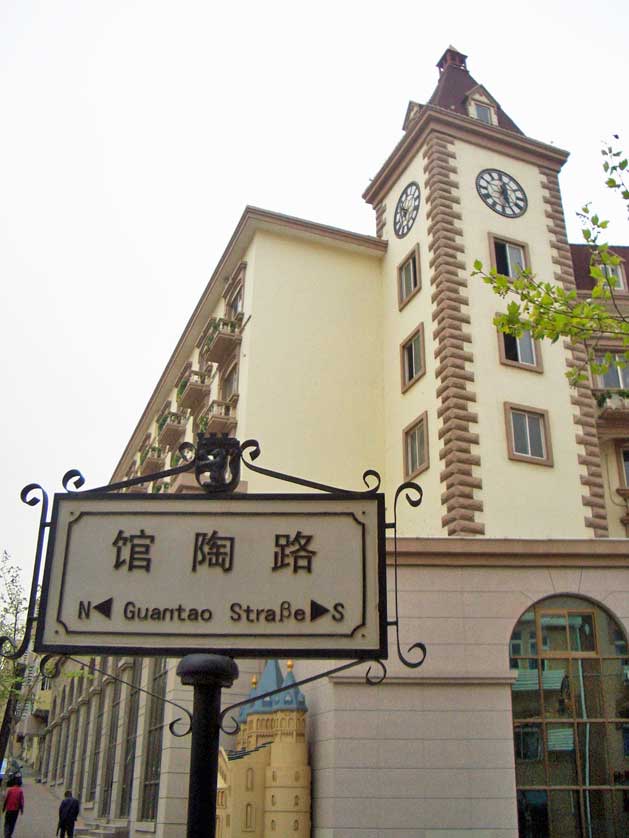
Guantao Straße
Nearby Guantao Lu / Guantao Street forms the heart of the old German neighborhood of Qingdao.
Almost all the structures along the street date back to the German colonial period and the succeeding years.
Street signs are bilingual, spelling out Guantao Lu in Chinese and Guantao Straße (Guantao Street) in German.
Grocery stores offer a large variety of foods imported from Germany, wine sellers offer European wines with a focus on the products of German vineries.
There are several German restaurants on Guantao Lu as well. The most noticeable are the Deutscher Imbiss, a sort of diner serving a variety of German sausages, including Thuringia and Nuremberg style bratwurst (fried sausage).
Zur Bierstube is a German pub restaurant, offering German beer in addition to the always present Tsingtao as well as traditional German dishes.
Tsingtao Brewery Museum
The Tsingtao Brewery Museum is a short taxi ride or a 20 minute walk away from Guantao Street.
Focusing both on the history and the current presence of Tsingtao Beer, the museum is housed in the original beer factory where the history of Tsingtao beer started. The factory is still in operation and part of the museum tours.
Current Tsingtao Brewery Co. Ltd was founded in 1903 by a British-German company operating out of Hong Kong as Germania Brauerei (Germania Brewery).
It has been run by many different owners since and it has become a global beer giant by now.
Museum tours display that history in detail. They then provide a peek into the current beer production at site.
A rather unusual feature of the museum is the Drunk Room. The room is architecturally designed to give visitors an impression of what it feels like to be seriously drunk.
See here an English-language video from Chinese TV with an introduction to the museum, including the Drunk Room youtube.com/watch?v=uV2YAt4FeCY
Address: Qingdao, Shibei District, Dengzhou Rd, Number 56-1
Shibei District neighbors Shinan District.
Opening times: July - September: 8 am - 6 pm, October - June: 8.30 am - 5.30 pm
Admission: July - September 60 yuan, October - June: 50 yuan
Free for children under 140 centimeters.
For adults, the admission includes a free beer tasting.
Website in Chinese tsingtao.com.cn
Qingdao Access & Essentials
Qingdao's main railway station is located in the Shinan district.
From Beijing, take a Beijing - Shanghai High Speed Railway train to Jinan, change there to the Jiaozhou - Jinan High Speed Railway. Qingdao Station is the terminus of the Jiaozhou - Jinan Line.
Qingdao Liuting International Airport serves many destinations within China as well as international destinations such as Hong Kong, Macau, Taiwan, South Korea and Japan. Long distance flights to Frankfurt, Melbourne and Vancouver are available.
Long distance buses run to and from the city to many destinations in China.
Qingdao Metro
4 out of a planned 11 metro lines are currently in operation in Qingdao.
Line 2 (color coded red) runs from Zhiquan Lu to Licun Gongyuan. Line 2 intersects with Line 3 at Wusi Guangchang and Li Cun.
Line 3 (color coded blue) runs south north from Qingdao Railway Station to Qingdao North Railway Station.
Line 11 (color coded dark blue) runs from Miaoling Road Station to Qiangu Mountain Station.
Line 13 (color coded green) runs in the south west of the city from Jinggangshan Road to Dongjiakou Railway Station.

Accommodation in Qingdao
Qingdao offers a wide variety of hotels from five star accommodation through business hotels to cheap budget guest houses.
As a major resort Qingdao has a large selection of places to stay. Five star luxury hotels include the The Westin Qingdao with flat-screen TV, air conditioning and minibar, the four star Holiday Inn Qingdao City Center and the five star Crowne Plaza Qingdao with Wi-Fi and cable TV, a heated indoor pool, three restaurants and free parking.
Book hotels in Qingdao - Agoda
Book hotels in Qingdao - Booking.com

Book Hotel Accommodation in China
Book Hotels in Beijing - Booking.com
Find Hotels in Beijing - Agoda
Search Hotels in China - Booking.com
Recommended Hotels in Shanghai China - Agoda
Budget Hotels in Beijing - Booking.com
Best Hotels in Sanlitun - Booking.com
Book Luxury Hotels in Beijing
Beijing Palace Museum Ticket (The Forbidden City)
Mutianyu Great Wall Ticket & Cable Car
Guide Books on Beijing & China