Mogao Caves Gansu Province 莫高窟

The Mogao Caves, 25 km southeast from Dunhuang in Gansu Province, hold precious Buddhist stone carvings and wall paintings that cover over 1,000 years of Buddhist art.
The first cave sanctuaries date from 366 CE and number now 492 in all. The site was an important staging post on the Silk Road on the edge of the Taklamakan Desert. It became an important site of both Buddhist worship and pilgrimage.
The caves are referred to in Chinese as the Thousand Buddha Caves (千佛洞). They are a UNESCO World Heritage Listed Site.
History
The Mogao Caves are grottoes created by Buddhist devotees over the ages, beginning in the seventh century. They are located about 25 km south-east of the city of Dunhuang.
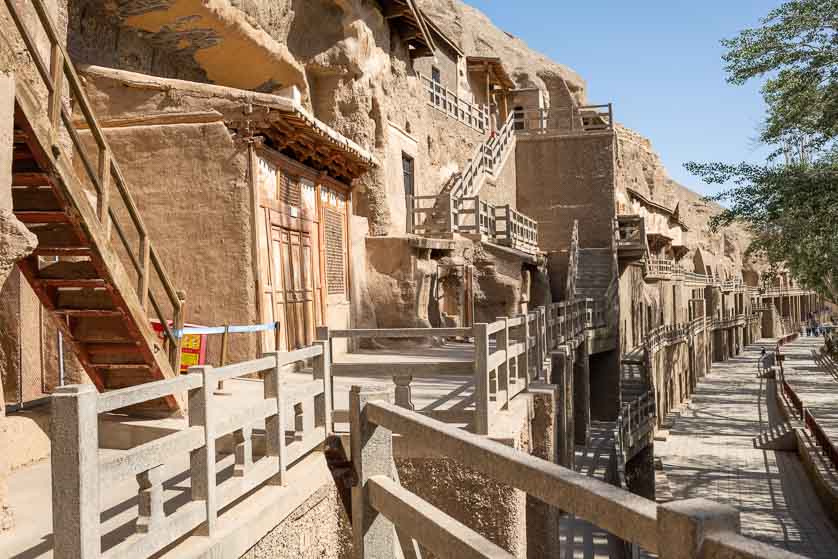
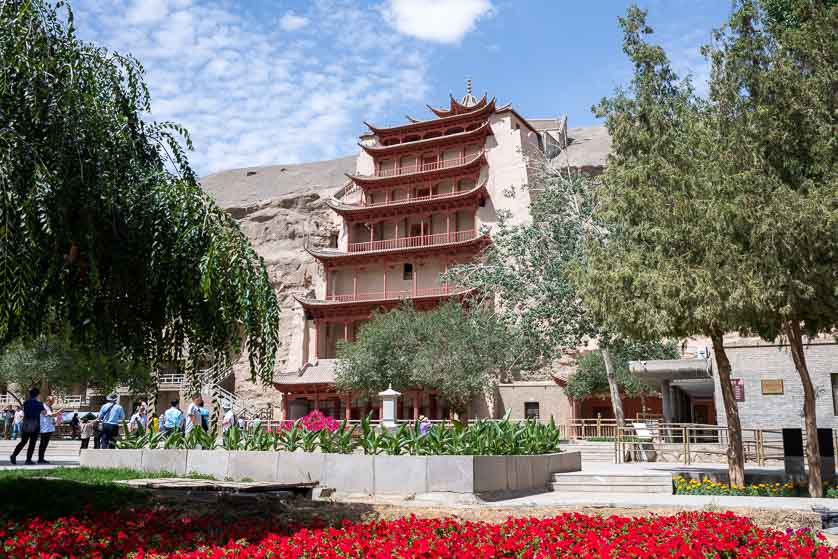
The caves are generally small, and are hollowed out of a long stretch of cliff. Today they have been given a protective concrete facade, complete with steps up to and doors on the caves, making most of the cliff look like a two-story human made structure.
This replaces the open caves accessed by ladders of old. Only a few of the hundreds of caves are accessible to tourists, but they are well preserved for their age.
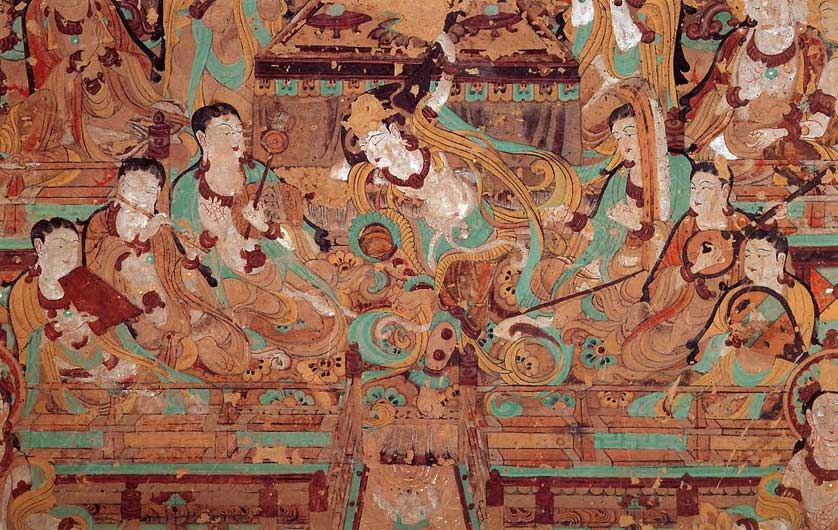
Inside the caves are both statues and painted murals, the latter covering the walls and ceilings of the caves. Altogether there are around 2,400 clay sculptures at Mogao. Cave 158 contains a 15.8 meter long Reclining Buddha in Tibetan style and Cave 96 a pair of Buddha statues - one 35.5 meters tall and the other 26 meters in height.
Frequently the arrangement of the figures in the caves is one of a central Buddha statue attended by surrounding figures of various arhats, bodhisattvas, devas, heavenly kings and other mythical creatures.
Photography is prohibited within the caves themselves.
Visitor Center
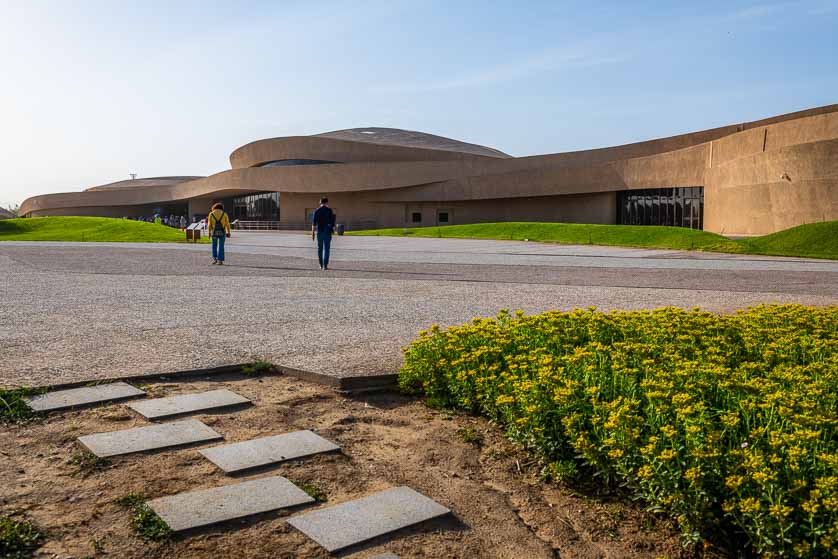
Visitors to the Mogao Caves first go to the visitor center, about a 15-minute drive out of the city, and a short ride from the caves themselves.
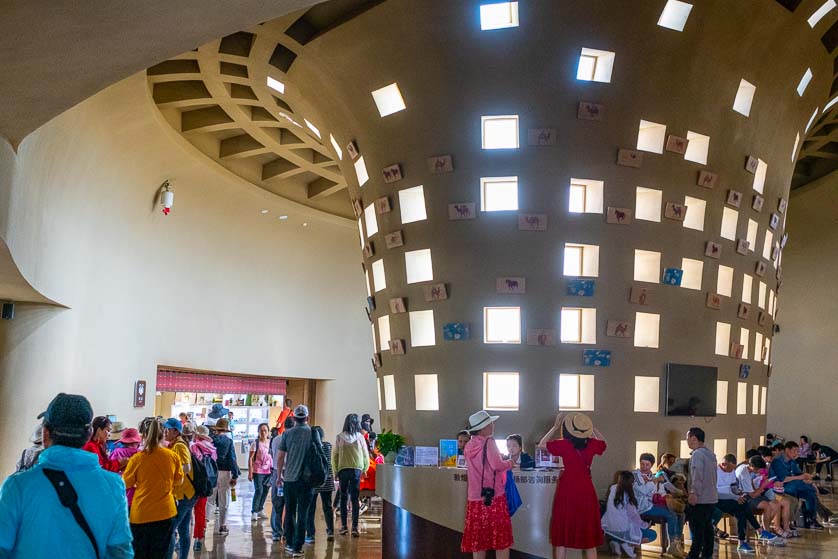
The modern, architecturally pleasing visitor center is where you purchase tickets to the caves, and also has two big-screen cinema spaces each with hundreds of seats.
The first shows a short film of the history of the Silk Road and the Mogao Caves. The second is a 3D presentation of the features and highlights of the caves. Both are excellent quality, and come with a wireless headset for English commentary if needed.

Dunhuang Research Academy
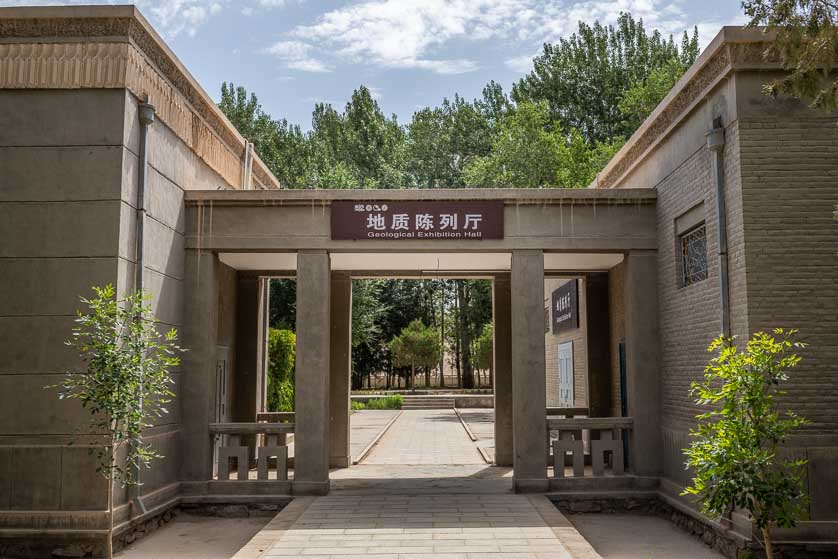
There is a museum nearby the caves: the Dunhuang Research Academy (DHRA), which is a large, modern establishment with numerous exhibits about the caves, and with an annex called the Geological Exhibition Hall.
Among the various exhibits from the caves are manuscripts from the Library Cave (see below), Buddhist banners, clay images, pottery and floor tiles.
Visit the official site for more information: en.dha.ac.cn
Library Cave & Dunhuang Manuscripts
In 1900 a Taoist priest Wang Yuanlu rediscovered the so-called "Library Cave" (Cave 17) which contained a huge haul of manuscripts, the majority Buddhist sutras, religious commentaries and treatises. Historians believe they were copied to obtain religious merit. Many are Chan (or Zen) Buddhist in nature along with several Tibetan Buddhist texts including Tantric Buddhism.
Taken as a whole these became known as the "Dunhuang Manuscripts."
As well as the collection of Buddhist documents there are also many secular scrolls (astronomy, divination, history, mathematics, music, philosophy, poetry etc) and writings on other religions including Nestorian Christianity and Daoism, written mainly in Chinese but also in other languages as well.
The scrolls are written on hemp, paper and silk and include the earliest dated printed book, the Diamond Sutra from way back in 868 (now in the British Library).
The majority are now kept in the in the National Library of China in Beijing. Manuscripts purchased at the time by Western scholars are also in the British Museum in London and the Bibliothèque Nationale de France in Paris.
Further Info - Getting to the Mogao Caves
Transport
Dunhuang Airport is the usual port of entry for visitors to Dunhuang. There are direct flights from Beijing and Shanghai. The flight time from those cities to Dunhuang is about three hours.
There are shuttle buses to the caves from the Mogao Caves Digital Exhibition Center (Visitor Center). This is about 2 km from Dunhuang Railway Station and about 12 km from the center of the city.

Book Hotel Accommodation in China
Book Hotels in Beijing - Booking.com
Find Hotels in Beijing - Agoda
Search Hotels in China - Booking.com
Recommended Hotels in Shanghai China - Agoda
Budget Hotels in Beijing - Booking.com
Best Hotels in Sanlitun - Booking.com
Book Luxury Hotels in Beijing
Beijing Palace Museum Ticket (The Forbidden City)
Mutianyu Great Wall Ticket & Cable Car