Christopher KL Lau
What compels a person to give up everything and cycle across the world? What compels them to attempt something similar and walk in a general southward direction from Mongolia to Hong Kong via China! These are the fascinating questions that global explorer and author, Rob Lilwall, will answer.

For the average person, traveling means so many things; to some, the chance to travel is to experience the world in all its wonder and beauty. To others, travel is an arduous task full of obstacles and uncertainties; to others, it is the combination of both the exploration and challenges which makes it so compelling and absorbing.
Rob Lilwall is a true adventurer in all senses of the word and by simply taking the path less travelled, he has transformed his life beyond his wildest imagination; he is now a motivational speaker, a published author and has his own National Geographic show.
An adventurer by heart, at the age of 27, he quit his teaching job and set off on his three year, 'Cycling Home From Siberia', expedition in September 2004. Three years is a long time and a person can gain a vast amount of knowledge and life experiences to share with others keen to learn, so upon completing 'Cycling Home From Siberia', Rob then lived in London for two and a half years, lectured extensively, wrote his first book (published by Hodder & Stoughton), and made a six-part TV series (with National Geographic Channel) about his bicycle expedition.

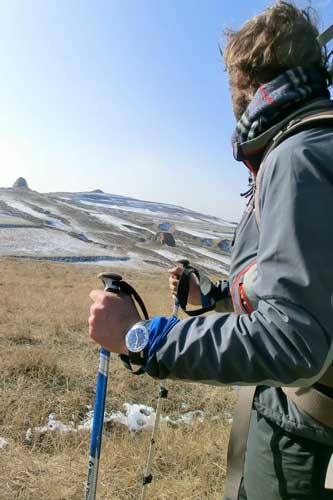
To further his religious interests, he also completed a theology diploma at Oxford University, and carried out two shorter expeditions, this time on foot: Walking a full lap of the M25 as well as walking through Israel and the West Bank. He also managed to get married as he also met his wife via this travels as he journeyed through Hong Kong on his first epic trip! Travel tend to always change a person for the better; there were no doubt times where Rob Lilwall had to become more optimistic, sharp, insightful and shrewd than he would be in normal circumstances to complete his journey.
Having spent three years cycling from sub-zero Siberia to London is enough to put some people off traveling for the rest of their lives, but to Rob Lilwall; it simply meant that there was yet another unbeaten path for him to conquer and of course, yet another documentary to film and a book to write.
Those who love travel are always looking for another reason or excuse to wander off the beaten path again so in November 2011, Rob Lilwall and expedition filmmaker, Leon McCarron, set off on an epic 5,000 km winter expedition through the heart of China.
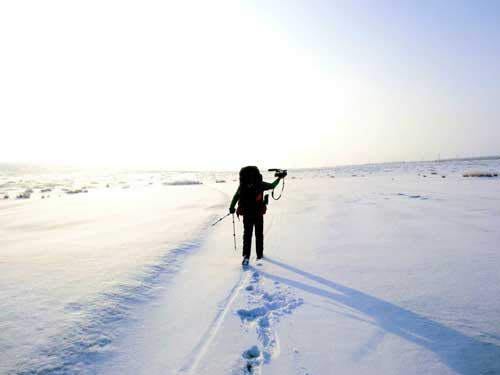
Instead of cycling this time, they would walk, yes walk, all the way back down from Mongolia to Hong Kong. Carrying all of their gear, they started amidst the wastelands of Outer Mongolia from where they head south by foot through the Gobi Desert.
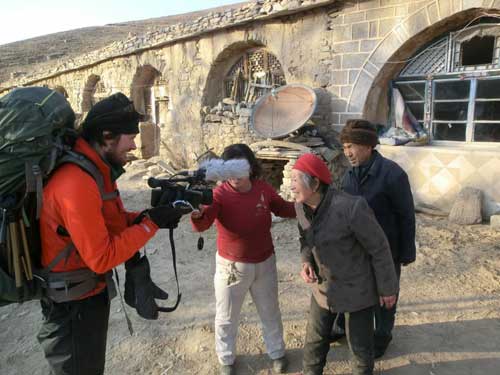
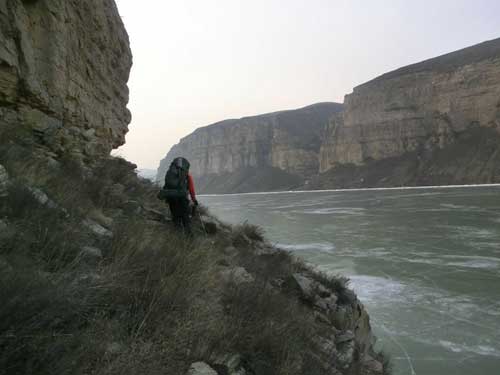
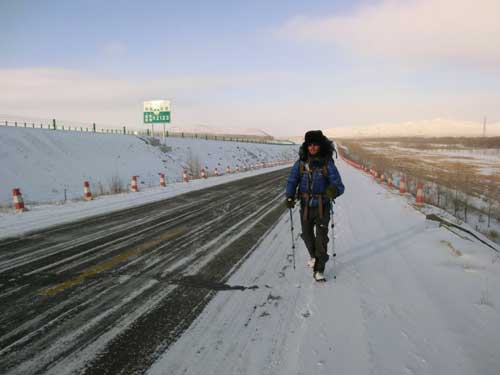
Here, they would encounter extremes of weather and of course, the isolation and wilderness. In the midst of all the walking were stunningly beautiful landscapes and unforgettable characters. From Mongolia, they then crossed into China, followed the Great Wall down to the turbulent waters of the Yellow River and walked alongside it downstream to the legendary city of Xi An. Leaving the water, they then hiked onwards through the snow-capped mountains of central China, until finally they reach their finishing point at the glittering skyscrapers of Hong Kong, in May 2012.
The expedition has been commissioned to become a television series, and it will also act as a sequel to Rob's televised three-year 'Cycling Home From Siberia' expedition. Rob is currently based in Hong Kong and continues with his speaking, writing and adventure career, as well as working as a fund raiser for the charity Viva that works with children at risk around the world. His latest book "Walking Home From Mongolia" was launched at the end of 2013.


Interview
In an exclusive interview, Rob Lilwall took time out of his busy schedule to answer a few questions.
Rob Lilwall: RL
Chris Lau: CL
CL: "What compelled you to go to Siberia and take the long way home? Where did this wanderlust come from?"
RL: "I had been a geography teacher after I left university which was my first full-time proper job but at the same time I was always interested in going on adventures. After teaching for a couple of years, a number of different factors came together and I decided that now was the time to go on a really big adventure. I was always interested in riding a bike across Asia and this idea had always been at the back of my mind. A friend of mine who was cycling all over the place and all over the world emailed me to ask me to ride across the Asia Pacific and I I thought to myself that if I don't do it now then I never will or it will be a lot harder if I don't do it now. I quit my job, brought myself a one way ticket and took my bike to North-East Russia and it took me about three years to cycle back!
First of all, I went through Russia in the winter, got to Japan and at that point, me and my friend split up and decided to cycle back separately. I cycled down to Australia which took about another year and a half and it took about another year to get back to London via Tibet and Afghanistan. I thought I would get back into teaching but a few other things came into play and I got a book deal and the National Geographic channel brought my video footage for my show. I also started speaking a lot, mainly motivational speaking and I met Christine who I had met as I cycled through Hong Kong. She was then working in London, so we got married and then moved back to Hong Kong. After two years of being married, I decided to go on another expedition where I flew to Mongolia and instead of cycling, I walked home! So this was my new expedition, 'Walking Home from Mongolia' where I basically walked back through China to Hong Kong".
CL: "Was it easy for you to drop everything and go? Many people would like to undertake an adventure like yours but their day to day circumstances simply does not allow them the opportunity?"
RL: "It wasn't very difficult for me. It quite scary to leave it all behind but I was single, I didn't have a mortgage and it is reasonably easy to go back to teaching after taking a couple of years out so in that sense it is pretty easy. On another level, most people have more opportunities then they think. I mean it is very hard to go away for three years in certain situations but a lot of people can take sabbaticals and take a bit of time out between jobs. Obviously if you have a young family then that makes it a lot harder but if your kids are not small, you can still go on trips and quite long ones, not quite three years; you can still on go decent length trips if you are prepared to make some sacrifices but it is good to remember that the winner in life is not gong to be the person with the biggest bank balance in the cemetery! A lot of people could do trips but there are a lot of reasons to stop them doing so but they can get around them if they really wanted too."
CL: "What did you learn about yourself and human condition on your last trip?"
RL: "I will talk about both trips. I think I learnt a lot of good and bad about the hospitality and kindness. Overall more good, I encountered a great level of hospitality. Total strangers have looked after me, be it a Russian gold miner in the middle of Siberia or a Mongolian nomad in the middle of the Gobi desert or a village in the middle of a jungle in PNG. I have met so many people who have looked after me and it has been a very wonderful experience. On the darker side, I have been robbed at gun point in Russia, I was robbed in the Philippines and sometimes you see some people simply being cruel to each other. Sometimes I placed myself through some testing situations and sometimes, I saw good things in myself, sometimes I was braver than I thought I was and sometimes I saw a lot of bad things, Sometimes I was selfish and self-centered.

CL: "Is it always as glamorous as it sounds? Sometimes, these trips just seem plain mundane?"
RL: "Yes, that's a very good point! Sometimes when you watch the National geographic television show, you would think it would be one adventure after the next. The reality is that nine days out of ten, not much happens! You get up and get on a bike and cycle for twelve hours then go to bed. Or you get up and walk for twelve hours and then go to bed. You might see a few beautiful things and you might meet some friendly people. but nothing super exciting happens and hour after hour, you are kind of lost in your own thoughts! And it can be like a slog and that is like all of life, when you have to get from A to B, in whatever you are doing in life."
CL: "Is there any single outstanding memory or are there to many to select from?"
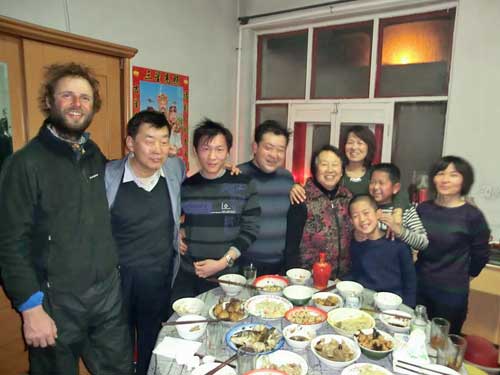
RL: "When you are at the end of one stage of one part of an expedition and entering the next, it is always magical. When we walked out of the Gobi desert and reached a town on the Chinese border, it was amazing as we had been in the desert for two weeks and then suddenly we were in an industrial town and it was quite an amazing experience! When we tried to find the Great Wall in Shanxi province, on its own in the countryside, it was amazing. When we found the Yellow River, it was amazing! It was amazing moments like that which stand out then actual landmarks. Some of hospitality as well, for example on Chinese New Year's eve, we were walking along the Yellow River and it was night time as we were behind schedule and as we were walking into this city, all of China was having a party and there were fireworks going off. Leon (Cameraman) and I, we were still walking, we were feeling lonely, tried and homesick and we were looking into everyone's windows and everyone was getting ready for their family banquets and suddenly this car pulled up next to us and this guy shouted to us, "What are you doing?" We said we were walking to Hong Kong and then we said "Well come back to my family's house for dinner!" So we marked our spot on the mark and he took us back for this wonderful Chinese New Year dinner. Really magical and special!"
CL: "Before your journey began, did you have any perception of certain peoples, countries or cultures?"
RL: "Often before I go to a country, I will research and read up a few good books so normally, I would know a little bit about the country and what to expect and what the people might be like. I guess when you get there, it is always an extraordinary experience; going to Japan for the first time and going round China! You always learn a lot. In places like Afghanistan and Iran which maybe on television may have a bad reputation, you sort of think that everyone there will be a terrorist. A vast majority of people are fine and obviously you have to be careful, very careful sometimes! You realize that most people are normal people trying to live a peaceful life and that's always nice to learn.
CL: "Can anyone attempt this feat? Do you have any advice for people who want to do something similar? Can anyone do this type of trip?"
RL: "I think pretty much anyone can do it. I have a friend who cycled from England to Australia and when he set off, he was something ridiculous like eighteen stone...a really fat guy and when he got there, he was the same weight as me! He had lost all his weight! He wasn't very fit when he started but he got fit as he went so this is why I think that almost anyone can do these trips! You have to be careful if you are going into more extreme weather obviously as you certainly are in danger if you don't know what you are doing. If the weather is OK then the number one danger you will face is the traffic. You have to be careful as cars are dangerous especially if you are on a bike. It was always good to go on a few shorter trips. It is always better to go on a few shorter trips and test out your equipment, learn what you are doing, camp in the wild. For example, if you are going on a six month trip and then it is good to maybe go on a one week trip or maybe a two week trip. A six month trip and a two year trip wont be that much different in many ways. If you have never done it then maybe do a few trips with a friend as it will give you a give you a lot more confidence and experience if you want to do a solo trip."
CL: "During your trip, did you ever feel lonely?"
RL: "Yeah, I did feel lonely though I am someone who is relatively content in my own company. I have ways to help with my own loneliness. I always had a books, or a Kindle so I could read when camping on my own. I always had an iPod so I could listen to music so those things helped. I would be able to an internet cafe to communicate unless I was in the desert. I am Christian so I would also pray."
CL: "Do you ever just want to give up and jump on a plane and go home?"
RL: "It was pretty rare for me to give up as I knew that if I was having a bad day then I knew it was just a bad day and week. I knew if I kept on going then I would have some really good experiences. I knew if i was having a bad day or week then got on a plane to go home then I knew I would be happy for a few days with hot pizza, showers and family / friends then a few days later, I would regret it forever; all the distance I had gone would all be wasted!"
The book "Walking Home from Mongolia" is now out in all good Hong Kong Book stores.
Walking Home from Mongolia - Walking Home from Mongolia on Amazon
Cycling Home from Siberia - Cycling Home from Siberia on Amazon

Book Hotel Accommodation in Hong Kong China
Book Hotels in Hong Kong - Booking.com
Hotels in Hong Kong - Agoda
Find Hotels in Kowloon - Booking.com
Peninsula Hotel Hong Kong
Search Hotels in Macau - Booking.com
Venetian Macau Resort Hotel
Budget Hotels in Hong Kong - Booking.com