Baijiu - Chinese Distilled Spirits 白酒
Johannes Schonherr

Today, beer is China's most commonly consumed alcoholic beverage, Shaoxing Rice Wine and the many other kinds of Huangjiu (黄酒) go down easily with virtually any Chinese meal.
Huangjiu translates as "yellow drink", it is an aged fermented grain-based liquor, similar to sherry in color, appearance and alcohol content if not in taste.
The Chinese drink with the highest prestige however is Baijiu (白酒). Baijiu literally means "white drink" though it is not white - it's a clear liquid that looks exactly like water or, maybe a better analogy, vodka.
Baijiu is a distilled spirit with an alcohol content hovering somewhere in the 50 - 60 volume percent area. There are weaker ones and stronger ones but 50 to 60 volume percent are the most common.
High quality baijiu is typically consumed in a celebratory fashion. At a grand party, the host might open a bottle or ceramic flask of one of the famous brands to impress his guests, Chinese businessmen like to celebrate successful deals with their trading partners by downing shots of high-price baijiu. Bottles of high-price baijiu are common gifts - and often used as bribes.

Baijiu Consumption
Baijiu is the most popular distilled spirit worldwide. With more than 10 billion liters sold in 2018, it is easily outselling the combined amount of whisky, vodka, gin, rum, tequila and the like.
By far the majority of that consumption takes place within China, however. Only a tiny percentage of the produced amount finds its way abroad.
Still, in Chinatown shops as well as well-stacked liquor stores around the world, a certain variety of baijiu is usually available. Those are normally the mid-level brands, selling in a range of about 20 to 200 U.S. dollars.
If you want to get a first impression of what a good baijiu tastes like, those are the ones to start with.
Most Westerners have initially an adverse reaction to the taste of baijiu. "Tastes like cold, sweaty old socks." and the like are typical comments by non-Chinese novices.
Some western people discover after repeated tries a whole new world of exciting tastes, others just use the drink to compliment unwanted guests out of the house.
Baijiu is an acquired taste… though many non-Chinese certainly never agree with the taste.
As much as the Chinese liquor industry would like to expand its reach beyond the borders, baijiu is a hard sell abroad.
In China itself, the range of baijiu available runs from the very cheap to the outrageously expensive.
Especially in northern China with its cold winters, people drink cheap baijiu to keep the cold away. There, cheap baijiu serves the same functions as vodka does across the border with Siberia.
For the other end of the spectrum, check out the duty free shops at Chinese international airports. There, you can easily find the high-class baijiu, typically coming in very unusually shaped bottles, sold in highly protective cartons to ensure that the product is really what it claims to be. On Chinese markets, fake products are a constant worry.
For the real high end stuff, however, you have to visit the specialized stores in Beijing, Shanghai or other major Chinese cities, or, even better, the factory outlet stores of the usually quite provincial towns where the baijiu is made.
The Making of Baijiu
Baijiu is generally made of grain. Beans are counted as grain in China, so there are also baijiu made from beans. The most common grains fermented for the drink are however sorghum, wheat and, of course, rice.
The process starts with fermentation, using a starter culture named Qu. Qu itself is a bacteria-rich culture made from cooked and then fermented grain.
The Qu brings the flavor out of the baijiu grain during a lengthy fermentation process. At the end of the process, there is huangjiu - itself a very fine drink.
To make baijiu, however, the huangjiu is then distilled, the result being a clear strong liquor. The liquor is stored in large ceramic jars until it has matured to the desired grade of quality. The aging process typically takes many years - just as it is with whisky.
Baijiu comes in four different kinds of aromas: rice scent, light scent, strong scent and sauce scent. Sauce scent baijiu goes down the throat very smoothly, it also matures the best when kept in long-term storage by the final customer. So, sauce scent baijiu is the most sought after, strong scent coming in second.
History of Baijiu
The history of alcohol consumption in China dates back many thousand years. Mostly however in the form of huangjiu, fermented grain drinks aka "rice wine".
Historians disagree when exactly distillation technology became available in China, essential for the making of baijiu.
They generally do agree, however, that by the time of the Ming Dynasty (1368 - 1644), the technology was in place. During the Ming and especially during the following Qing Dynasty (1644 - 1911), the production and consumption of baijiu spread all over China.
Maotai 茅台
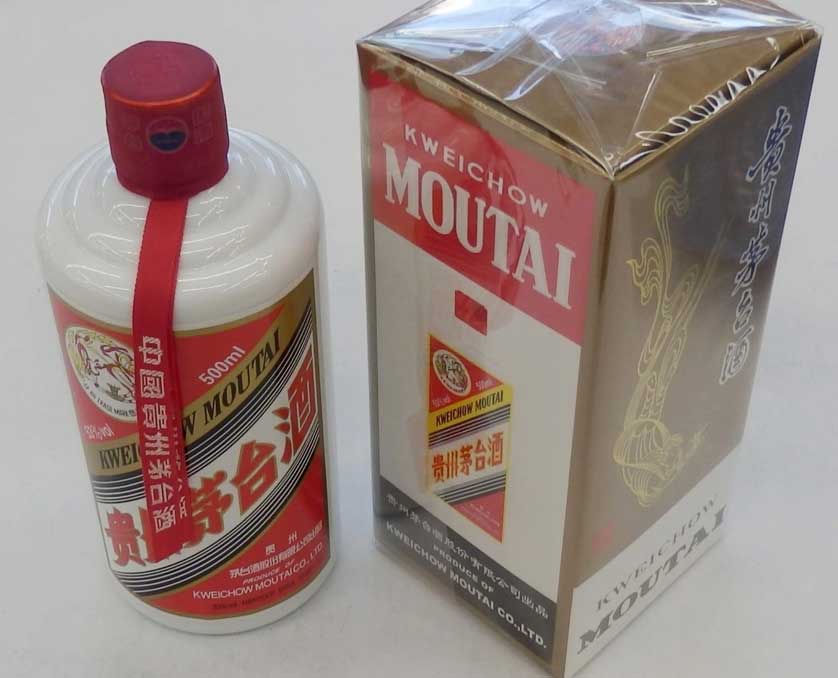
One baijiu, Maotai (also often called Moutai), has a very special place in modern Chinese culture. Maotai has been produced in the small town of Maotai in Guizou Province, southwestern China since the days of the Qing Dynasty, using only the water of the Chishui River flowing through the town as well as only locally grown sorghum as main ingredient and a locally produced Qu starter culture.
Maotai liquor first rose to international prominence in 1915 when it won a major prize at the Panama - Pacific International Exposition, a world's fair held in San Francisco.
During their legendary Long March (1934 - 1935), Mao Zedong's Communist rebel army stayed for a time in the vicinity of Maotai town. The rebels used the Maotai drink to cure wounds and illness, they imbibed it to regain mental strength.
Many of the rebel leaders fell in love with the Maotai baijiu as a drink that decidedly helped their cause.
Two years after their victory in the Chinese Civil War in 1949, the new Communist government declared Maotai as the new national drink of China.
In 1951, the Maotai production companies were brought under government control and consolidated as the Kweichow Moutai Company, Kweichow being an old Romanization of Guizou and Moutai an old spelling of Maotai town.
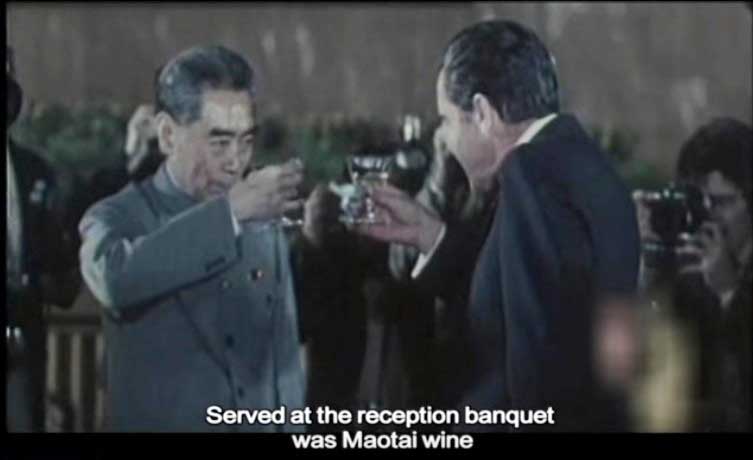
Especially Zhou Enlai (1898 - 1976), the first Premier of Communist China championed Maotai liquor.
Most famously, he used it to have toasts with U.S. President Richard Nixon at their first meeting in 1972. In the same year, the drink got instantly famous in Japan when Zhou Enlai exchanged Maotai toasts with Japanese Prime Minister Kakuei Tanaka.
When Deng Xiaoping visited the United States in 1974, Secretary of State Henry Kissinger told him, "I think if we drink enough Maotai we can solve anything."
That didn't mean that Henry Kissinger particularly liked the drink. At one point he compared it to "drinking kerosene".
Kissinger was (and is) not alone with this sentiment. For Chinese government officials and business people, however, Maotai is the best and most precious they can offer to a guest or trading partner.
Refusing the drink when offered might be considered a grave affront.
See here an English subtitled video produced by Chinese TV detailing the history and importance of Maotai to modern China. The video also shows footage of Maotai town itself - it looks like quite a lovely place.

Yanghedaqu 洋河大曲 – Trying the Spirit
Despite having traveled to China numerous times, I've had so far never encountered a situation requiring any official baijiu toasting with either government officials nor business people.
So, I cannot personally attest to the atmosphere surrounding a true baijiu toast in China.
I could however buy a bottle of Yanghedaqu at my local liquor store in Japan, a 52 volume percent alcohol baijiu.
According to website baijiublog.com, a British site dedicated to Chinese spirits, Yanghedaqu ranks as one of the top ten baijiu.
Along with Maotai but at a fraction of the price. While a bottle of basic Maotai comes to more than 300 U.S. dollars, the bottle of Yanghedaqu I bought was merely a bit more than 30 dollars.
The cardboard box containing the bottle was not that easily to open. I had to cut through a security seal, to push in buttons and to pull out plastic levers. All installed to prevent any re-use of the carton by counterfeiters.
Once I could open the box with the final help of a box-cutter, a blue glass bottle in decidedly old fashioned Chinese design appeared.
Screwing open the hard plastic bottle top, some silvery material adorning the bottle right below the top crumbled down. Another safety feature, obviously.
I should have invited a group of friends and made the opening of the bottle the center of some party. Doing so, I could have gathered their opinions on the taste and smell of the drink.
Unfortunately, the country was under a virtual lock down due to the coronavirus at the time of this writing. Any party situation was out of the question.
So I did what baijiu is absolutely not designed for: sipping it by myself in front of the computer.
The drink has an intense but pleasant smell. The taste is quite strong and hard to define but to me at least, absolutely agreeable.
The 52 volume percent alcohol quickly shot to my head. Be careful with that drink, I told myself: a few more glasses, and you will sing its highest praises while the keyboard keys will start to dance. Pack it away and wait for an opportunity to serve the precious Yanghedaqu to friends when social distancing has become a thing of the past.


Beijing Stay
Book Hotels in Beijing - Booking.com
Find Hotels in Beijing - Agoda
Search Hotels in China - Booking.com
Recommended Hotels in Shanghai China - Agoda
Budget Hotels in Beijing - Booking.com
Best Hotels in Sanlitun - Booking.com
Book Luxury Hotels in Beijing
Beijing Palace Museum Ticket (The Forbidden City)
Mutianyu Great Wall Ticket & Cable Car