Slow Boat Through China: See the Yangzte in style aboard a luxury cruise ship
Daniel Allen
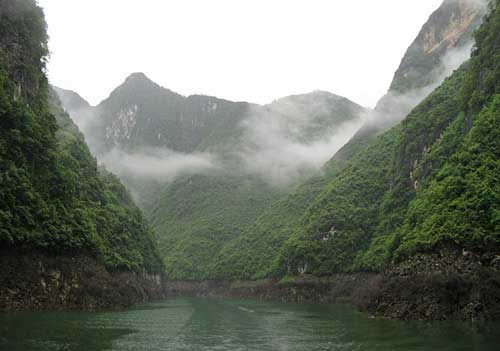
A day downstream from the city of Chongqing and the languid Yangtze coils snake-like through a narrow chasm between two mountains. On each side the ethereal silhouettes of forested slopes fade into the mist, as passengers line the decks of the Sanctuary Yangzi Explorer, clutching their cameras as they crane their necks to take in the dramatic environment. Ensconced in luxurious surroundings, the boat's 150-strong contingent are about to sail through a succession of iconic Chinese scroll paintings.

Qutang Gorge
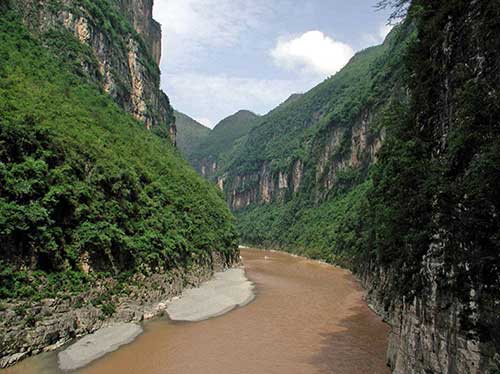
But even the most beautiful paintings and photographs fail to capture the magnificence, mystery and mood of the Qutang Gorge. It was the tendrils of mist that clung to its vertiginous sides, swirling auspiciously in the shape of dragons, that once inspired a powerful Chinese warlord to establish a base here on the north bank of China's mightiest waterway. Today the scenery is no less bewitching.
Known as the cradle of Chinese culture, in many ways the Yangtze remains the life blood of China - today its waters are used for commercial transport, irrigation, drinking, bathing and leisure cruising. It is divided into three sections: the Upper Reaches (which includes the Three Gorges), the Middle Reaches, and the Lower Reaches.

The world's third longest river, the Yangtze rises from the elevated, icy wastes of the Tibetan Plateau before flowing over 6300 kilometres to enter the East China Sea near the sprawling conurbation that is Shanghai.

From its humble beginnings, the Yangtze soon swells to become stately and symbolic. In addition to its varied landscapes of epic beauty, it provides the backdrop for countless Chinese fables and legends. It is also the location for one of mankind's most ambitious and controversial projects - the Three Gorges Dam - a concrete leviathan whose construction has allowed supersized tour boats to travel farther upstream than they ever could in the days of Mao Zedong.
Three Gorges Dam
The Three Gorges Dam may have been completed only recently, but according to the Chinese, planning it took the best part of a century. Many claim that the original idea was conceived in 1919 by Sun Yat-sen, the founder of the Republic of China. It wasn't until China's economic boom years, however, that the communist party could begin to realize his dream of a dam so powerful that it could provide energy for the Chinese masses.
Roundly criticized for its detrimental effects on the environment, supporters of the dam nevertheless point to the marvel of its engineering. It can now generate as much energy as 15 nuclear power stations; it has subdued a notoriously dangerous river (in the past flooding of the Yangtze inundated huge areas of surrounding countryside); and it has resulted in the development of a massive reservoir that extends over 600 kilometres back from the lip of the dam.
"A third of China's population live along the Yangtze and many thousands have died as a result," explains Beijing-based Chinese historian Chen Yan. "In 1931, nearly 150,000 people died in Wuhan (a city halfway between Chongqing and Shanghai) when the river flooded. But now the city is planning to build the world's tallest skyscraper. This is how the dam has changed people's thinking. It has made people feel safe."
It is the Three Gorges reservoir which now laps at the piers, quays and harbours of Chongqing. Between this bustling city of 30 million and the dam itself lie three gorges of legendary beauty that were previously only navigable by small boats. With myriad historical sites dotted along the banks, a trip through this reservoir offers an extraordinary insight into China's past glories and contemporary innovation and economic muscle.
Cruise Ships
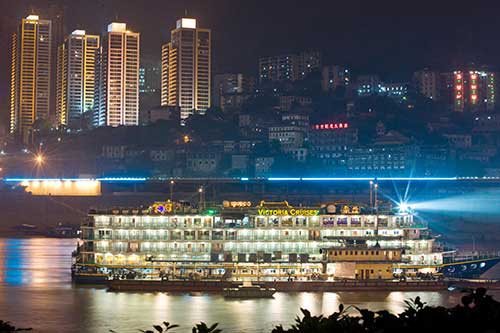
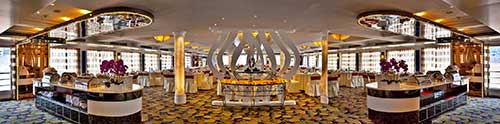
Today a fleet of cruise ships, some more opulent than others, ferries travellers along the upper stretches of the Yangtze. A typical river cruise takes four days, travelling downstream toward Yichang. The journey takes in the famous Three Gorges, day trips to relocated towns, an exploration of the Shennong Stream, and a trip through the dam itself.
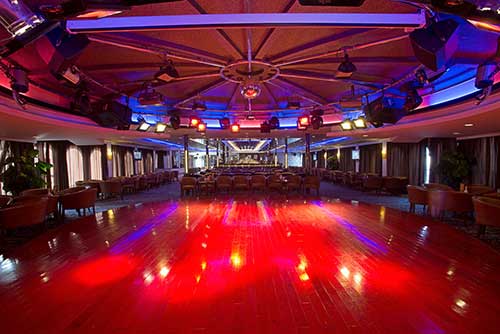
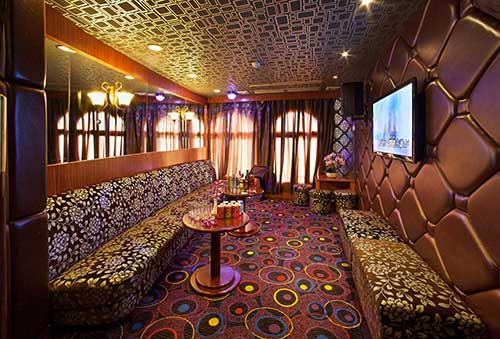
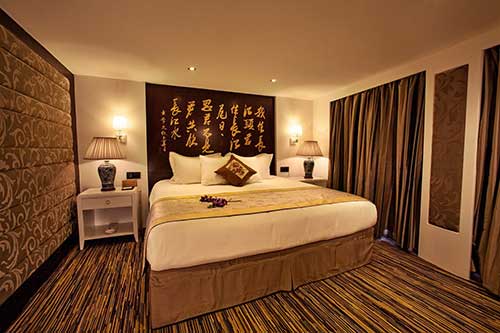
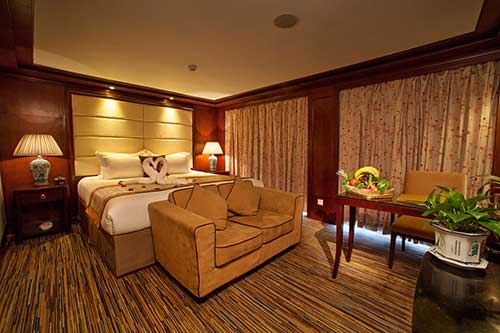
The sheer immensity of the Yangtze means that it has none of the restrictions on cruising posed by European rivers, such as low bridges or changing water levels that can affect itineraries. The largest and newest boats, some as large as ocean-going vessels, boast a fantastic range of amenities, including restaurants serving international haute cuisine, sumptuous cabins, silent propulsion systems, spas and indoor pools. The only problem passengers have here is how to balance luxuriating on board with exploring the sights as the ships dock each day.
Shibaozhai Fortress
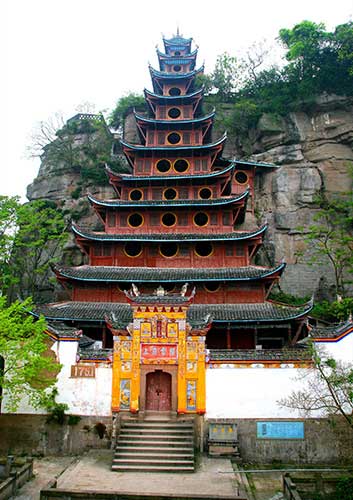
The first sight downstream from Chongqing is an architectural marvel that could hardly be more different to the Three Gorges Dam. Constructed from crimson-painted wood - without the use of a single nail - Shibaozhai is a 12-storey pagoda-fortress that reclines against the side of a sheer cliff face for support. Dating back to the eighteenth century, it is truly a magnificent structure that is known across China as the "Pearl of the Yangtze".
"Shibaozhai Fortress, which literally means 'precious stone fortress' in Chinese, is famous for its numerous interesting stories," explains cruise tour guide Amy Zhang.

"According to Chinese legend, the giant stone on the hill where the fortress is built was left by the goddess Nuwa. This is the source of the name 'Shibao' (precious stone)."
Shibaozhai was originally constructed in 1819, with each of the 12 storeys dedicated to a famous general of the Three Kingdoms Period, a famous poet or a local scholar. After the Three Gorges Dam was built rising water levels saw the pagoda encircled by a large lake (a large wall was built to protect it), which on many days now reflects its striking architecture with perfect clarity.
At the very top of the hill, above Shibaozhai, can be seen the three-storied "Purple Rain Pavilion," which was built during the reign of Emperor Xianfeng (1851-1861) and dedicated to the Buddhist boddhisattva Manjusri.
"Prior to the construction of the pagoda, visitors to the pavilion were hoisted to the top using a system of chains," explains Amy Zhang. "This must have afforded some fantastic views, but also been a little on the scary side, especially for those who suffered from vertigo."
Qutang, Wi & Xiling
On the second day out from Chongqing passengers awake to the spectacle that is the Three Gorges. Of these, Qutang is the most narrow, Wu is the most beautiful, and Xiling the most dangerous, due to concealed boulders and swirling currents. For most of the year all the gorges are shrouded in mist, which only adds to their air of mystery.
At eight kilometres in length the Qutang Gorge is also the shortest of the Three Gorges. The river surges through sheer, steep cliffs here, passing by the so-called "Meng Liang staircase", a natural rock structure supposedly carved by a Song Dynasty bodyguard. At certain points in the gorge the width of the river is reduced to less than 50 metres, while the major peaks on each side tower overhead. With several switchbacks along its length, these narrow canyons create a succession of stunning panoramas.
Southwest of the Qutang Gorge lies the Kui Gate, also known as the Qutang Pass, which is one of the most dramatic natural spectacles on the cruise (it is also depicted on the 10 yuan note in Chinese currency). The river is so narrow here that it almost feels as though you could reach out and touch both walls with your hands.
The Kui Gate is created by two peaks - Mount Baiyan and Mount Chijia - both of which soar to heights of well over 1000 metres. As the Yangtze passes between these massive stone sentinels, its brown waters swirl and churn as the captain of the ship fights to keep control, his vessel dwarfed by the awe-inspiring scale of the surrounding landscape.

Twelve Peaks of Mount Wu
500 kilometres downstream from Chongqing cruise ships enter Wu Gorge - the second of the Three Gorges - which is widely known in China from a succession of famous Tang Dynasty poems. With broader waters, it is also known as "Witches Gorge" because of its treacherous and twisting nature. It extends 40 kilometres from the mouth of the Daning River to the walled town of Wushan.
Wu Gorge is the gateway to Sichuan, the largest and most populous of China's twenty-one provinces. With a hundred million inhabitants and an area slightly greater than that of France, it consists of a prosperous eastern plain encircled by mountains. For centuries the Yangtze gorges were Sichuan's only means of communication with the outside world.
Traversing Wu Gorge passengers enjoy a natural gallery of beautiful sights. Forest-clad slopes run down to the river on each side, while clouds of "witches' brew" - or diaphanous mist - swirl overhead, trapped in the narrow, steep-walled canyons. The highlight of the gorge is Shi'er Feng - or the Twelve Peaks of Mount Wu - a series of cloud-covered mountains which line up on each side of the river.
"So steep are the cliffs and so thick is the mist that the sun rarely shines in the Wu Gorge," says Amy Zhang. "It can be quite eerie at times. According to Chinese legend the gorge's 12 peaks once protected boatmen on the Yangtze from 12 dragons. Today passengers often liken each range to the half-submerged tail of a giant crocodile."
By the end of the Xiling Gorge - the longest of the three gorges at over 60 kilometres - cruise ships have entered Hubei Province, home to the Three Gorges Dam. Cruise ships en route to Yichang, the usual end point of a four-day tour, must pass through the dam, in itself an incredible experience.
A symbol of China's rush to modernize, the Three Gorges project is China's largest since the Great Wall in the second century BC. Over 25,000 workers worked over 13 years to build the dam, at cost of around US$30 billion. However you feel about its huge impact on the Yangtze and its environs, its scale is undeniably breathtaking.
Due to the construction of the dam, all vessels must be lifted or lowered over 90 metres. Because of this great height, the water pressure required for a single lock would be too much for one gate to withstand. Instead, the dam uses five locks, each capable of holding six 10,000 tonne ships, with a total transit time of two to three hours.

China has a habit of exhausting superlatives. As the gargantuan gates of each lock clang shut and the rising water begins to churn, the entire scene is illuminated by what must be the world's hugest floodlights.
"The whole experience never fails to impress me," says Amy Zhang. "Inside the lock each flotilla of vessels is like a pod of trapped whales, waiting for release. The size of the machinery makes you feel truly insignificant."
Always fond of their proverbs, the Chinese have a well-known saying: "If you haven't travelled up the Yangtze, you haven't been anywhere." Today, thanks to the Three Gorges Dam, passengers can travel farther along this mighty river - in greater luxury - than ever before. Those on a slow boat through China have never had it so good.
China Travel Articles
Beijing Architecture
Commune By The Wall
Luxury Train to Lhasa
Summer in Chengde
Tianjin Architecture

Hotels in Shanghai
Book Hotels in Shanghai - Booking.com
Find Hotels in Pudong Shanghai - Booking.com
Shanghai Marriott Hotel City Centre - Booking.com
Courtyard by Marriott (Shanghai Disneyland) - Booking.com
Hilton Shanghai - Booking.com
Search Hotels in Shanghai - Agoda
Grand Hyatt Shanghai - Agoda
Budget Hotels in Shanghai - Booking.com
Shanghai Disneyland Admission Ticket