Shanxi on the Side 山西
Daniel Allen

Shanxi Travel Guide 山西
While Shanxi Province is richly endowed with cultural and scenic attractions, few overseas visitors venture beyond Pingyao, Datong or Tai Shan. Here are a couple of less well known attractions that merit a detour from the usual Shanxi tourist circuit, and make for a great weekend break for bored Beijingers.
Qiao Da Jia Yuan (Qiao Family Compound)
Shanxi Province was famous in the Qing Dynasty for its trading companies and remittance houses, and a number of the rich Shanxi merchants constructed extensive, courtyard-style homes for their clan.
One of the richest Shanxi families was the Qiao family, and they built what has become one of the best preserved and most interesting of these Shanxi merchant family compounds. Many Chinese movie buffs will recognize Qiao Da Jia Yuan as the place where Zhang Yimou's movie Raise the Red Lantern was filmed.
Begun during the reign of the Qing Dynasty's Emperor Qian Long and finished in the 18th century, Qiao Da Jia Yuan is a huge courtyard estate covering 9000 square meters, with a grand total of 313 rooms and 25 courtyards of various sizes. From the air the it appears to spell out the Chinese word for happiness, and architects consider it to be one of the finest remaining examples of imposing private residences in northern China.
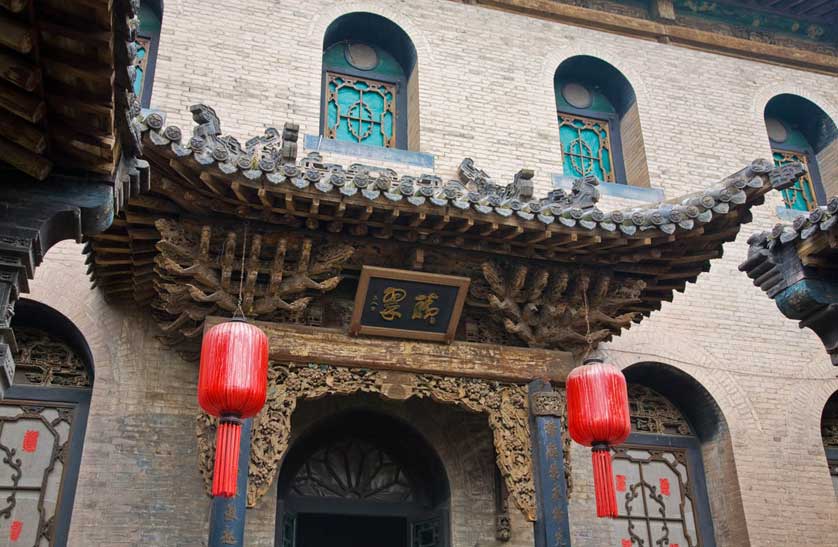
Situated around 30 km north of Pingyao and 50 km south of Taiyuan (capital of Shanxi), Qiao Da Jia Yuan was originally constructed in 1756 by Qiao Guifa, a merchant who made his fortune selling tea and bean curd in Inner Mongolia. After amassing his pile Qiao returned to his hometown in Shanxi and set about constructing his dream house, which was subsequently modified and expanded by later generations.
The Qiao Da Jia Yuan complex is laid out in the shape of the Chinese xi character (喜喜), meaning "double happiness." After entering through the main gate, visitors walk along a path leading to the main hall, which is the family's ancestral hall. This path divides the compound into southern and northern sections. Both halves have three courtyards each.
Qiao Da Jia Yuan is not only notable for its size, but also for the exquisite craftsmanship displayed in its numerous brick carvings, woodwork, murals, and inscribed tablets. Many of these carvings contain special meanings, often based on the pronunciation of the items depicted in the carvings. The doors, windows, eaves, pillars and railings of these structures are all beautifully made. The wide variety of different roof styles is particularly interesting, and there are over 140 chimneys in the compound, each with its own unique design.
Further Info Minibuses run regularly to Qiao Da Jia Yuan from both Taiyuan and Pingyao (very cheap). Both Taiyuan and Pingyao are on the train line from Beijing. There are numerous bullet trains from Beijing West to Taiyuan, the journey takes around 3 hours and tickets are 150 to 200 RMB.
Entrance fee: 40 RMB (discount for children, students and seniors).
Jin Ci (Jin Temple)
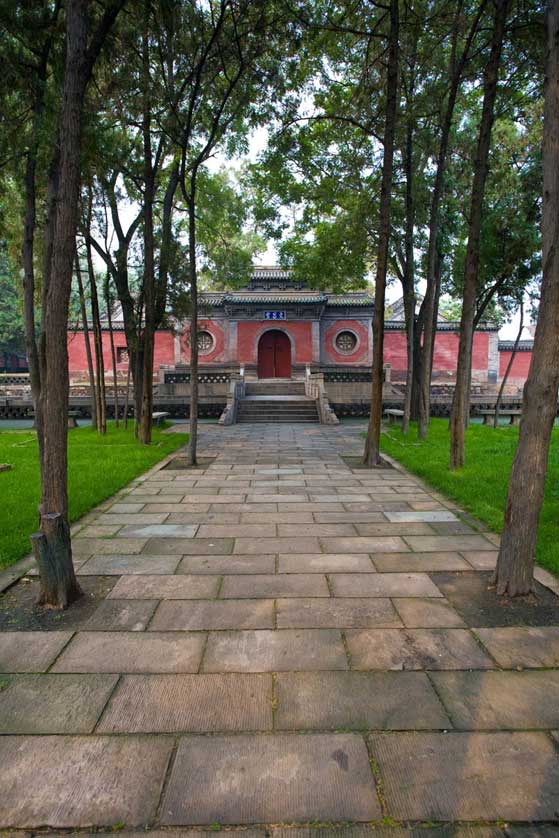
Jin Ci, an ancient ancestral temple (something of a rarity in China), was founded about 1400 years ago, and subsequently expanded during the Sui, Tang, Song, Yuan, Ming, and Qing Dynasties. These expansions have left the temple with a variety of architectural styles, and today the temple complex comprises of over 100 halls, towers, pavilions, terraces, and bridges. The grounds boast some of the best Song Dynasty sculptures in China, as well as some very old trees (including a 3000-year old cypress) and picturesque scenery.
Conveniently located on the outskirts of Taiyuan, Shanxi's capital and largest city, Jin Ci sits at the base of Xuanweng Mountain at the Jin Springs, source of the Jin River. The ancient State of Jin (11th - 4th centuries BC) got its name from this river, and Jin was the ancient name for Shanxi Province. (In fact, the license plates of all cars from Shanxi still feature the character Jin.)
Jin Ci's history can be traced back to the Western Zhou Dynasty (11th century BC to 711 BC), when King Cheng made his younger brother Yu a leader of one of his states. Yu was an intelligent leader who devoted all his energies to making the state prosperous, so his descendants built a temple for him after his death to honor his achievements.
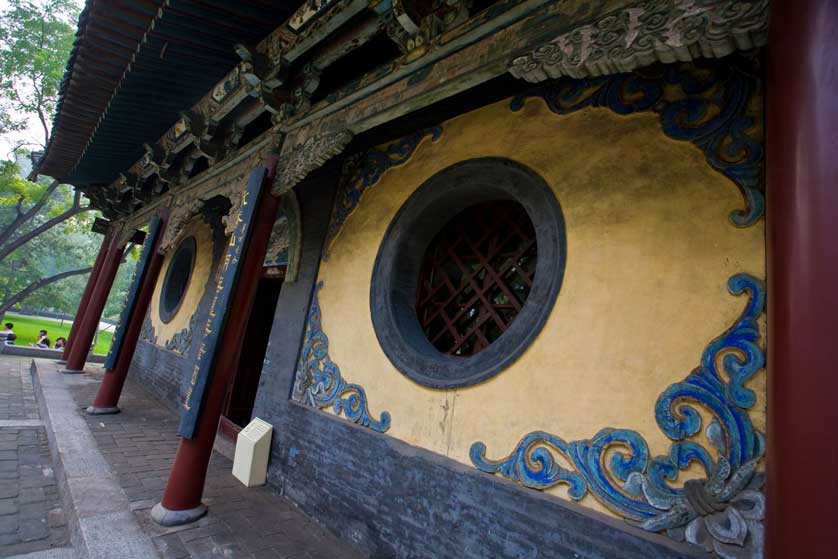
Jin Ci's most famous structure is the Hall of the Holy Mother, located at the back of the complex. With carved wooden dragons coiled around the eight pillars that support its upward-curving double-eave roof, this impressive structure is one of the largest surviving buildings remaining of the Song Dynasty, and is one of the oldest wooden halls in China.
Inside is Yijiang, Tang Shuyu's mother, seated calmly and surrounded by 42 servants, eunuchs, actresses, and handmaidens. Each of these delicate attendants has a different expression, and it is said that one of the handmaidens has four different expressions when viewed from four different angles.
There are numerous other structures at Jin Ci, and one can easily spend a whole day visiting the many buildings and touring the gardens. Another structure worth seeing is the 700-year old Shuyu Temple building on the north side of the complex, which features more carved clay handmaidens, this time carrying musical instruments.
Further Info - Getting to Jin Ci
Jin Ci is about 25 km southwest of Taiyuan. There is a regular bus service from the main bus station. Taxi fares should be no more than 60 RMB. Entrance fee: 70 RMB (discount for children, students and seniors).
- Hotels in Shanxi Province
- Taiyuan Hotels
- Water Hotel Pingyao
- Datong Garden Hotel
- Pingyao Yide Hotel
- Pingyao Guangxu Palace Boutique Hotel

View more images of China by Daniel Allen
Book Hotel Accommodation in Beijing China
Book Hotels in Beijing - Booking.com
Find Hotels in Beijing - Agoda
Search Hotels in China - Booking.com
Recommended Hotels in Shanghai China - Agoda
Budget Hotels in Beijing - Booking.com
Best Hotels in Sanlitun - Booking.com
Book Luxury Hotels in Beijing
Beijing Palace Museum Ticket (The Forbidden City)
Mutianyu Great Wall Ticket & Cable Car