Zhaoling Tomb, Shenyang: Perfect for a Rainy Day 昭陵 沈阳
Johannes Schonherr
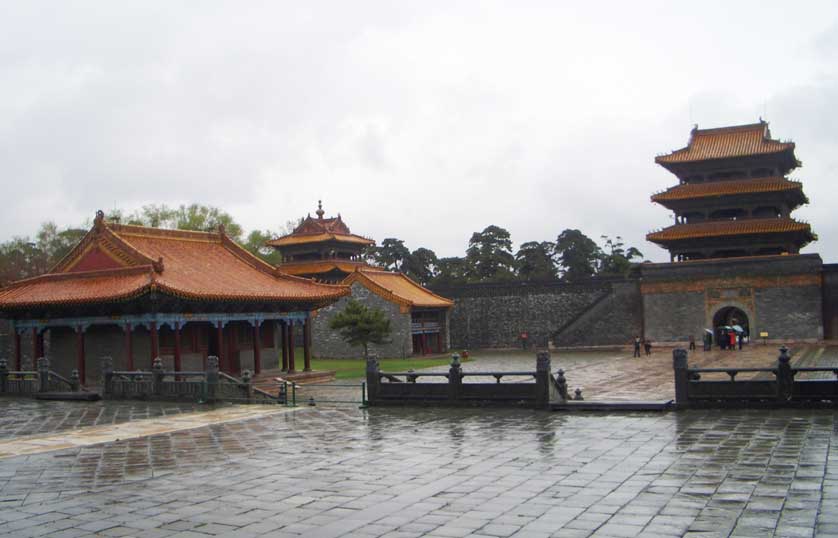
Visiting a city with a bit of time to spend and then suddenly experiencing a rainy day?
Most cities just turn grey and inhospitable and you get the feeling of just wanting to be somewhere inside. In a café or something just to pass the time.
But some cities have places designed to visit while the heavens weep. Imperial graves for example.
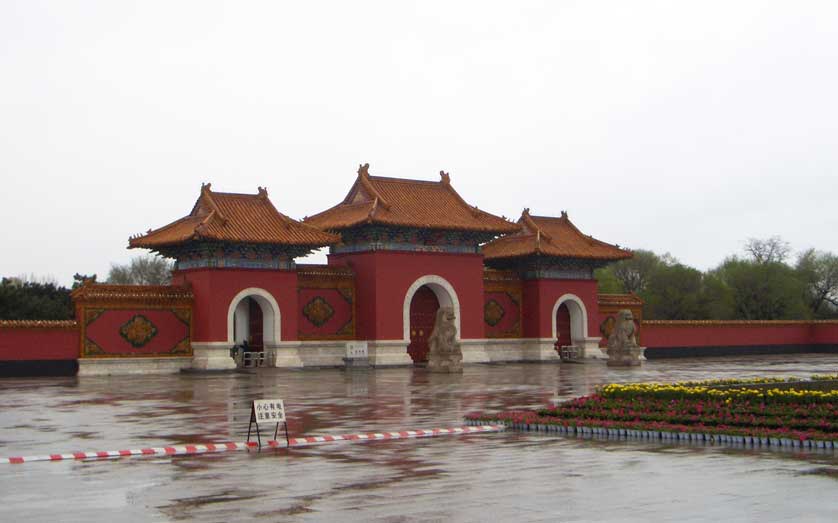
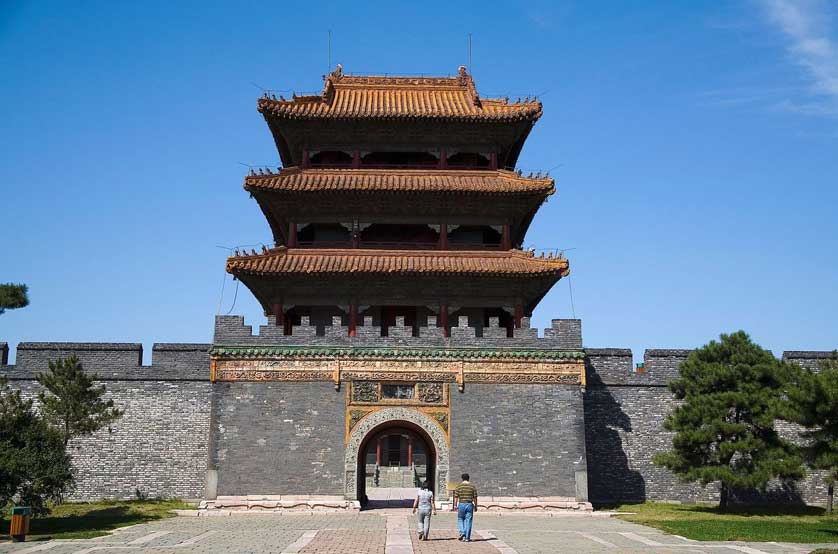
Count yourself lucky being in Shenyang, Liaoning Province on a day of drizzling rain. It gives you the chance to visit perhaps the most beautiful and best preserved Imperial grave in China, the Zhaoling Tomb in the perfect condition it should be seen.
Take Metro Line #2 to Beiling Park Station in the north of the city, unfold your umbrella and enjoy the beauty such a rainy day can bring out.
Beiling Park, which translates as "North Tomb Park", is in fact worth visiting in any weather. It is Shenyang's largest park and it offers many attractions even on the brightest days of the year.
Heading for the actual tomb, however, I would rather choose a less sunny day.
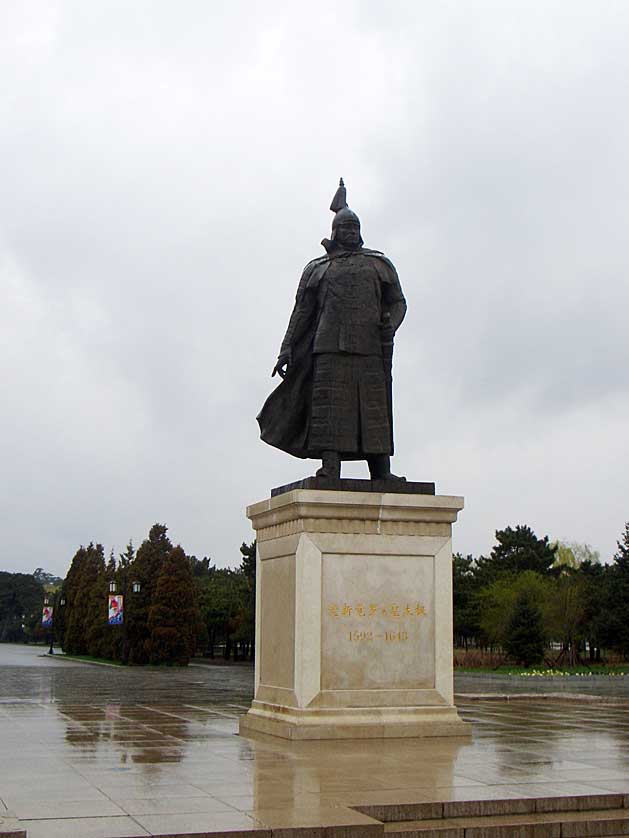
Emperor Hong Taiji
Before going there, though, you might want to know a little about the tomb you are going to visit.
Emperor Hong Taiji (1592-1643) and his wife, Empress Xiaoduanwen, are buried there. Hong Taiji is considered the founder of the Qing Dynasty, which ruled China from 1644 to 1911, even though he died before his armies conquered Beijing in 1644.
Hong Taiji was the eighth son of Manchu Khan Nurhaci (1559 - 1626) who, attacking out of the sub-Siberian flatlands of northern Manchuria, captured Shenyang in 1625, taking it from Ming Dynasty China (a dynasty that lasted from 1368 to 1644).
Nurhaci, Hong Taiji's father, renamed Shenyang as Mukden, thus giving the town its Manchu name.
Nurhaci also ordered a group of Manchu academics to develop a writing system for the Manchu language, drawing on the Mongolian writing system. Manchu writing is still commonly seen today in north-east China. Most famously, it is one of the languages printed on Chinese bank notes.
Nurhaci's son, Hong Taiji, however had bigger plans: taking over all of China was his goal.
Even though he was the eighth son of Nurhaci, the crown was handed to him at the passing of his father. He was certainly the most intelligent, the most courageous and most ambitious of Nurhaci's sons.
Soon after he was installed as the new Manchu ruler in 1626, he started his expansion plans.
When the neighboring Chinese tributary state of Korea didn't want to follow his lead, he conquered Korea and made it a tributary state to his Manchu empire.
Then, he set out to conquer China proper. Hong himself died while the conquest was still in progress (in 1643) but the army he had set in motion prevailed. Beijing was taken in 1644.
Upon arrival at the Forbidden City in Beijing, his successors established the Qing Dynasty and ruled China from 1644 all the way to 1911.
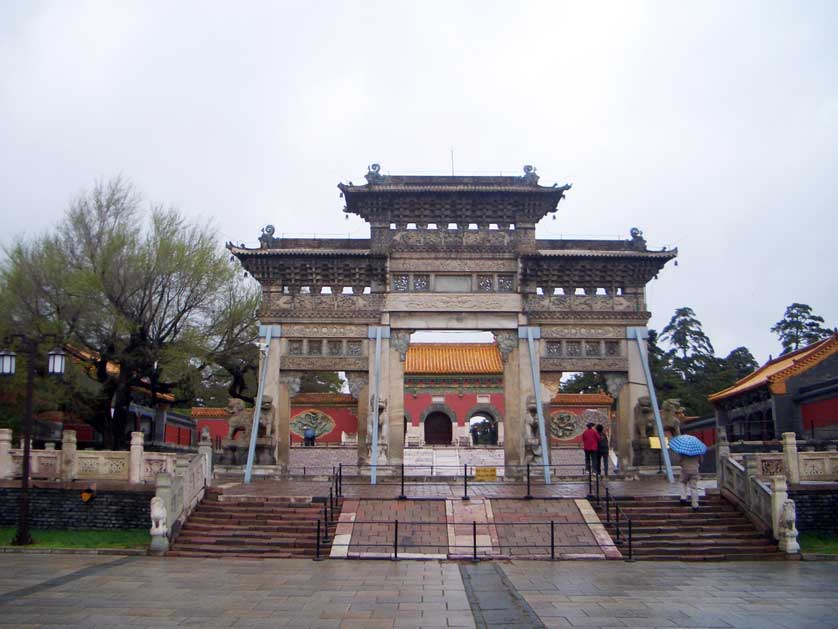
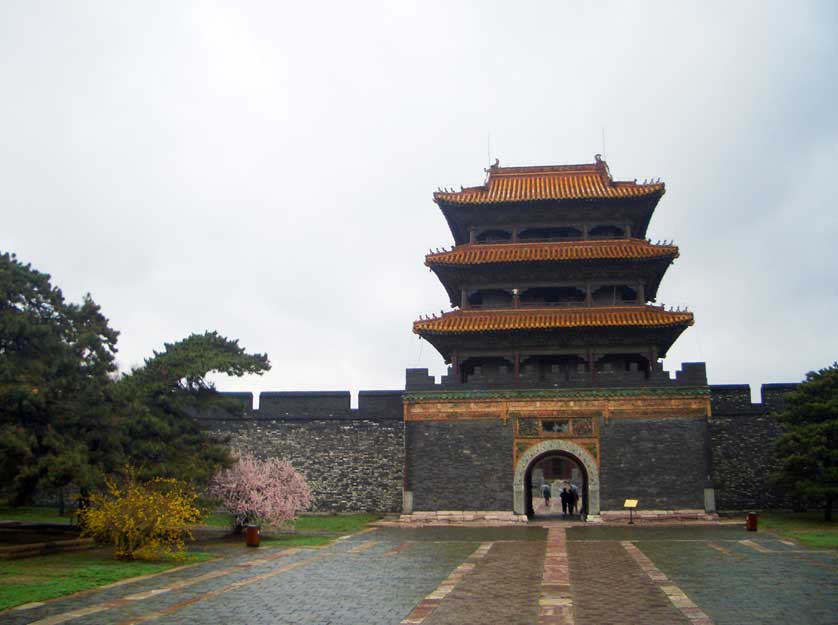
Zhaoling Tomb
Being credited as the founder of the Qing Dynasty, his grave became a major shrine for the new dynasty. Only the most skilled architects were chosen for the work on his eternal tomb.
It took his heirs eight years to complete the work from 1643 to 1651. The whole area, roughly today's Beiling Park, was declared an Imperial Area which no commoners were allowed to enter.
At given anniversaries, the ruling emperor would travel there with his entourage, engaging in holy ceremonies in honor of Hong Taiji.
Three paths led to the tomb from the southern end of what is now Beiling Park. The central path was reserved for the Gods and the bearers of offerings, the path to the left was used by the Emperor and his entourage, the path to the right by government officials.
It's hard to imagine the scope and design of those celebrations today. They must have been overwhelming for all participants.
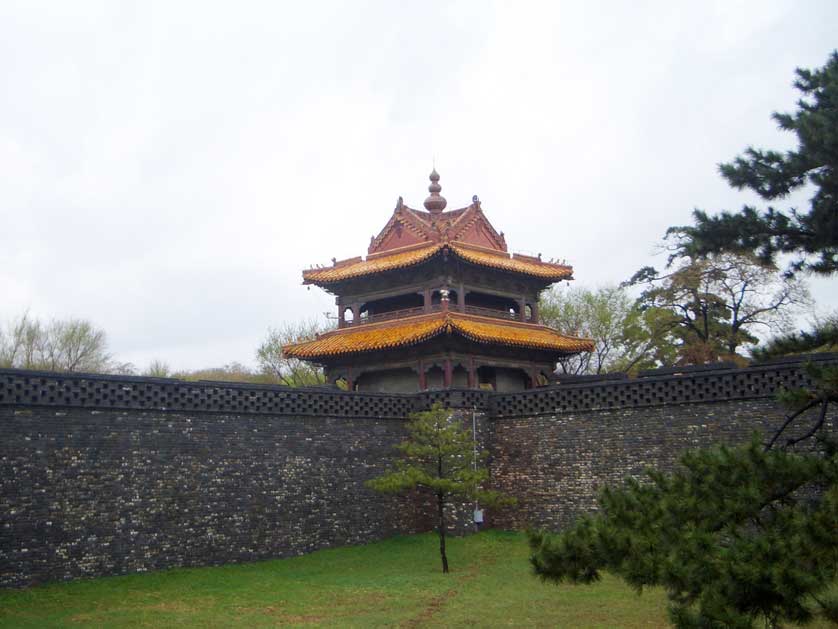

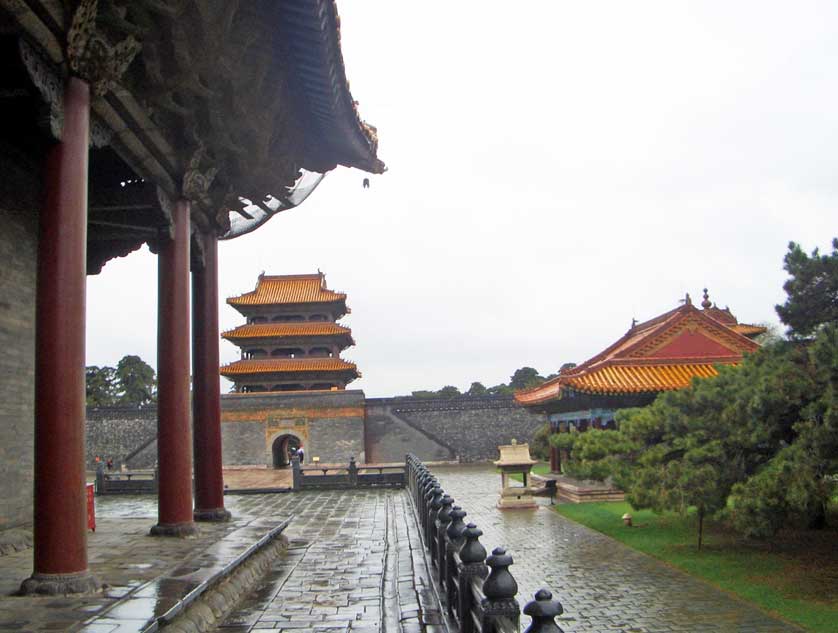
The Tomb Today
The Chinese Revolution of 1911 replaced the Qing Dynasty with the newly founded Republic of China. It took up to 1927, however, until the Zhaoling Tomb complex was opened to the public, along with the opening of Beiling Park.
Today, next to nobody visits the site specifically to honor Hong Taiji. The Qing Dynasty is ancient history.
The beauty of the site with its colorful and well-preserved historical Manchu architecture however is a major draw.
All three ancient paths to the Zhaoling temple complex are open to the public now. The path to the left, the one used by the Emperor, is the closest to Beiling Park metro station.
It is about a 1.2 km walk from the Beiling Park entrance to the actual Zhaoling Tomb complex.
About halfway along the Emperor's path stands a statue of Hong Taiji.
You pass through a number of gates, often decorated with sculptures of animals, before you reach the tomb temple complex.
That is the place to visit. It displays wonderful examples of ancient Chinese and Manchu architecture.
You can walk on top of the walls, you see the various buildings where Imperial offerings were prepared, where worshipping ceremonies took place, inside one of the structures the offerings were burned after being presented to Hong Taiji at his final resting place.
The altar building where the offering ceremonies took place can be entered.
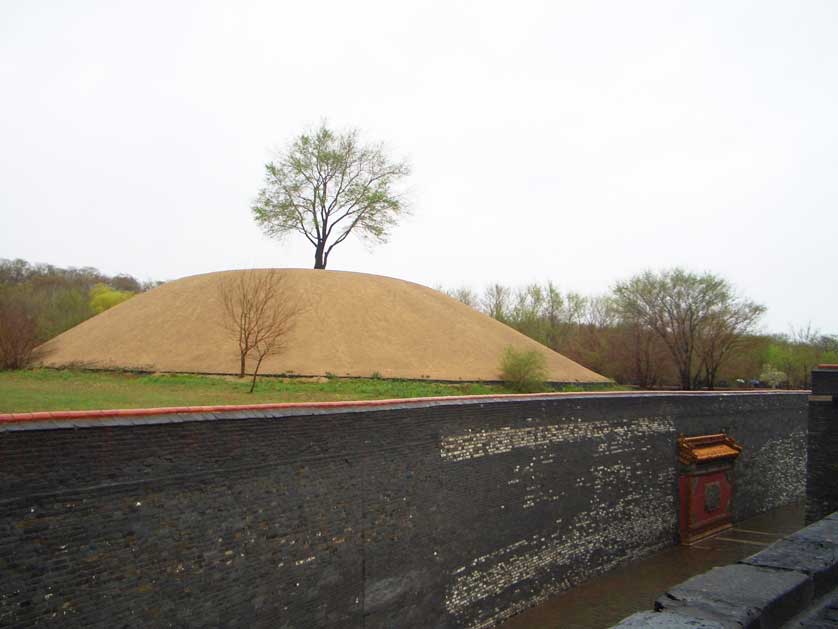
You can't walk, however, through the final gate leading from the altar building to a pathway behind which a large metal gate leads right into the actual tomb mound.
The tomb mound has remained closed since the burial of Hong Taiji and his wife. No, doubt, priceless offerings rest with them.
In a way, the grave is still sacred.

Access
Take Shenyang Metro Line 2 to Beiling Park Station. Follow the signs from there.
Open daily from 8 am to 5 pm.
Admission: April to October 50 yuan, November to March 30 yuan. Children shorter than 1.3 meters can visit for free.
Admission to Beiling Park is 6 yuan. If you have a ticket for the Zhaoling Tomb, you don't need to pay the park entrance fee.
Tel: 24 8691 0461
Shenyang can easily be reached by train from Beijing and other destinations in China. Shenyang's main train is the Shenyang North Railway Station. There are trains to Beijing, Changchun, Dalian, Fushun and Harbin.
The Qinhuangdao-Shenyang high-speed railway connects the two cities.
Shenyang Taoxian International Airport offers flights to virtually all other large population centers within China as well as international connections to Tokyo Narita, Seoul Incheon, Taipei, Bangkok, Singapore, Frankfurt and more.
There are long distance buses from the city to Beijing, Harbin and Dandong.
Within Shenyang, three metro lines operate, providing easy access from Shenyang North Railway Station to many of the interesting spots in the city.
Only Metro Line 1 stops at Shenyang North Railway Station, though. To get on Line 2 or Line 9, you have to first take Line 1 from the train station, then change at the respective transfer stations. All directions are clearly marked in English.
The Metro system is constantly being extended, new stations added.
Figuring out bus routes might be difficult if you don't read Chinese.
Taxis on the other hand are cheap and reliable. The drivers will most likely not speak English and might not understand your pronunciation of a Chinese address. Show them a print-out of your destination in Chinese and they will get you there the quickest way they can.
I rode Shenyang taxis that drove on the sidewalk to circumvent traffic jams. Those drivers do anything to serve their clients.
Shenyang Metro
The Shenyang Metro consists of three lines: Line 1, Line 2 and Line 9.
Line 1 runs 28 km east-west and is color-coded red. It connects Shisanhaojie in the west with Limingguangchang in the east. It began operations in 2010.
Line 2 runs 32 km north to south from Putianlu to Quanyunlu. It is color-coded yellow and opened in 2012.
Line 9 also runs roughly north to south and then loops east from Nujianggongyuan to Jianzhudaxue. It is presently nearly 29 km in length, is color-coded blue and opened in 2019.
Accommodation in Shenyang
Shenyang offers a wide variety of hotels from five star accommodation through business hotels to cheap budget guest houses.
Starting at the top, luxury hotels in Shenyang include the 5 star Conrad Shenyang, with an indoor swimming pool, Wi-Fi and fully-equipped fitness centre.
The 5-star Le Meridien Shenyang Heping on Bei'er Road also has a spa, indoor pool and full Wi-Fi.
The Hilton Shenyang on Qingnian Avenue has a fully-equipped fitness centre an a large indoor pool.
Book hotels in Shenyang - Agoda
Book hotels in Shenyang - Booking.com
Book Hotel Accommodation in China
Book Hotels in Beijing - Booking.com
Find Hotels in Beijing - Agoda
Search Hotels in China - Booking.com
Recommended Hotels in Shanghai China - Agoda
Budget Hotels in Beijing - Booking.com
Best Hotels in Sanlitun - Booking.com
Book Luxury Hotels in Beijing
Beijing Palace Museum Ticket (The Forbidden City)
Mutianyu Great Wall Ticket & Cable Car
Guide Books on Beijing & China