Monks Go Martial: A brief history of kung fu and Shaolin Temple 功夫
Daniel Allen
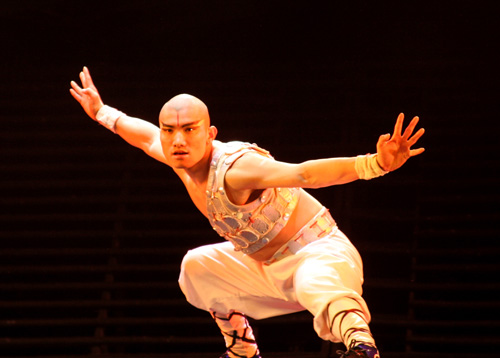
China probably has the world's longest and most diverse martial arts heritage. In fact, the Chinese consider their martial arts firmly rooted in the pre-historical age, during a time of conflict between humans and animals, and then primitive tribal warfare.
From countless battles, experience was accumulated and techniques discovered which were passed down from generation to generation.
With the development of materials and weapons so new fighting techniques were created, and different Chinese schools and styles originated and competed with one another.
From these early beginnings Chinese martial arts then proceeded to incorporate different philosophies and ideas into their practice - expanding in purpose from self-defense to health maintenance, and finally as a means of personal development.
Chinese martial arts today are a well-established and renowned part of the country's culture, and their influence can be found across society in such diverse areas as fitness and film through to painting and literature.
Many of the Chinese schools or styles of martial arts based their techniques directly on natural fighting techniques - on mammals and reptiles (tiger, panther, monkey, snake, bear), on birds (eagle, crane, chicken), or on insects (praying mantis).
It was believed that in order to survive these animals needed a natural talent and skill for fighting, and that the best way to learn fighting techniques was by studying and imitating them.
For example, the spirit and strength of the eagle, the leap of the tiger, and the stabbing motion of the crane's beak were all incorporated into various styles.


Kung Fu Styles
There were also common themes to the different styles, which are often classified by "families" (jia), "sects" (pai), or "schools" (men). Apart from mimicry of animal behavior, others gained inspiration from various Chinese philosophies, myths and legends. Some styles put most of their focus into the harnessing of qi energy, while others concentrated solely on competition and exhibition. Each style offered a different approach to the common problems of self-defense, health, and self-cultivation.
According to Chinese legend, the earliest forms of recognizable martial arts were introduced during the reign of the Yellow Emperor or "Huangdi", who came to power around 2698 BCE. The Huangdi is described as a famous general who, before becoming China's leader, wrote lengthy essays on medicine, astrology, and martial arts. He allegedly developed the practice of "jiao di" ("horn-butting" or Chinese wrestling) and utilized it in his military campaigns.

Shaolin Kung Fu
The world famous Shaolin kung fu style, tied to the Buddhist Shaolin Temple in Henan Province's Song Shan Mountains, today refers to a collection of Chinese martial arts. Of the tens of thousands of kung fu styles, several hundred do, in fact, have some relationship to Shaolin - however, aside from a few very well known systems, such as the Shaolin Five Animal, 108 Movements of the Wooden Man Hall, Enchanted Staff, and White Eyebrow, it is almost impossible to establish a verifiable connection to the Temple for any one particular style.
Shaolin Temple itself has a venerable history. According to one of China's oldest administrative books, a Buddhist monk name Batuo came to China preach in 464 CE Thirty-one years later, in 495 CE, Shaolin Temple was built by order of Emperor Wei Xiao Wen (471-500 CE) for him to teach from. Batuo can therefore be considered the first chief monk of Shaolin Temple, although there is no record of how or when he died, or exactly what he preached.
More influential than Batuo in Shaolin's development was an Indian monk named Da Mo, believed to have been born around 483 CE. Da Mo was invited to China to preach by Emperor Liang Wu (516-528 CE), but when the emperor decided he didn't like Da Mo's Buddhist theory, the monk wisely retreated to Shaolin Temple.



Da Mo
When Da Mo arrived at Shaolin he saw that the other monks were weak and sickly, so he shut himself away to ponder the problem. After nine years of seclusion he wrote two classic texts that eventually helped the Shaolin monks get fitter and stronger, and kung fu exercises were incorporated in their daily regime. From that time onwards the Temple has always been associated with kung fu, and Shaolin monks have helped various emperors fight battles. The Temple's monks continued to integrate a range of martial arts skills into their techniques over the years, and even took Shaolin kung fu to Japan.
Today several interesting structures are open to Temple visitors, including the standard Bell and Drum Towers. There is also the Hall of the Heavenly Kings, Mahavira Hall (the temple's main building, built during the Jin Dynasty and restored in 1986), and the Sutra-Keeping Pavilion, with well over 5000 Buddhist sutras in its library. Fangzhang Hall traditionally served as a resting place for the temple's abbots - in 1750 the Qing Emperor Qianlong lived in this building for a time.
Further Info on Shaolin
Location
Shaolin Temple is situated in the foothills of the Song Shan mountain range just fifteen minutes outside the town of Dengfeng, which is about two hours from Zhengzhou, the capital of Henan Province. Buses run from Zhengzhou and Luoyang, another larger Henan city, to Dengfeng. Alternatively, if you are staying in Zhengzhou or Luoyang, you can arrange a day tour from your hotel. Including a brief hike in the mountains and a visit to Bodhidharma's cave there is enough to keep visitors occupied for a whole day.
Temple opening hours: 8am - 5.30pm, all year (there are various shows at different times during the day, so it is advisable to arrive early)
Admission: 110 RMB (incl. electric bus)
Transport
There are many trains leaving Beijing West Station that go to or pass through Zhengzhou - the quickest is the D131 which takes a little under 5 hours. For cheap flights check elong at www.elong.net
China Hotels
Book Hotels in Beijing - Booking.com
Find Hotels in Beijing - Agoda
Search Hotels in China - Booking.com
Recommended Hotels in Shanghai China - Agoda
Budget Hotels in Beijing - Booking.com
Best Hotels in Sanlitun - Booking.com
Book Luxury Hotels in Beijing