Ditan Park Book Fair (地坛公园)
Dave Green
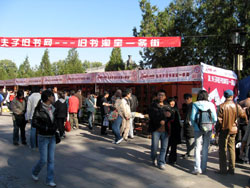
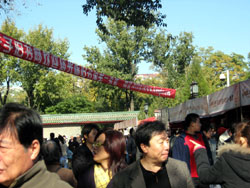
Beneath the eaves of Di Tan's Park's sparsely leafed cypress trees, the alleys and paths surrounding the ancient Earth Temple are buzzing with life.
Here in the New China, the eighth autumn book fair is in full swing.
The two-story central terrace, once used as a sacrificial altar to pay homage to the Earth God, is now surrounded by newspaper stands, and a black stage has been erected on the north side of the plaza.
Up on the stage, a wiry 73-year-old man limbers up for his performance in front of an expectant throng. He does not disappoint, walking across the platform on his hands with enough ease to give the crowd a wink halfway through. He then goes on to explain the source of his remarkable good health and directs the crowd towards the stalls selling tai chi and qi gong instruction manuals for further enlightenment.

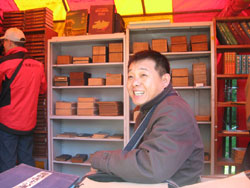
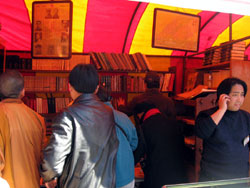
In many ways, the Di Tan Park book fair is representative of the New China. No opportunity to do business is missed. Besides books and magazines of every description, the fair is home to stalls selling Chinese and foreign CDs and DVDs, arts, crafts and clothing. Makeshift food stalls display kebabs as long as your arm and others brew dou zhi, a sour porridge beloved of Beijingers. There's even a booth selling insurance.
The thirst for knowledge is apparent in the crush of bodies that pack every walkway around the temple. Yet it was not so long ago that the Cultural Revolution policy of burning books inspired one of China's greatest authors, Ba Jin, to compose the lines:
"I myself destroyed books, magazines, letters and manuscripts which I had kept as treasures for years...I completely negated myself, literature and beauty...I even believed that an ideal society was one where there was no culture, no knowledge, and of course no literary resources."
Ba Jin later became chairman of the Chinese Writers' Association, and was instrumental in warning future generations of the dangers of forgetting their cultural history.
The success of this year's new attraction, the Kongfuzi Old Book Street, which sells classical Chinese textbooks from the Ming and Qing dynasties, is testament to China's desire to reconnect with its past and the aptitude of the market to provide its citizens with an opportunity to do so.
Zhao Aijun, founder and director of kongfz.com, the company that runs the street, says:
"It attracted thousands of visitors and readers. However, there weren't too many foreigners there, possibly because it was the first time we did this and we hadn't done enough work on promotion. We're going to change that in the coming fair, which is due at the beginning of January 2008 (H Su book fair, it's called). We've already started to prepare for it."
According to Zhao, next year's fair will also include literature classics and history chronicles. Exhibition rooms will display special books, such as rare first editions, and experts will give lectures on their history and significance.
The fair is also worth a visit for those whose Chinese is not up to reading Ming classics in the original. Most visitors enjoy delving into the collections to see what they can find, but while it is possible to find random books and periodicals in most of the world's major languages, it helps to have a clue where to start.
Prominently displayed on the west side of the temple plaza (at Section 2, No.99 if you want to be precise) are the stalls of the China National Publishing Industry Trading Corporation (CNPITA).
The company is unique at the fair as being the only importer of foreign, and especially English, books.
Novels by such literary luminaries as V S Naipaul, John Le Carre and Patrick McCabe are widely available at knockdown prices (10Y for a novel). There are also non-fiction texts on everything from media law to microbiology.
Mr Wu, who has run a CNPITA stall almost every year since the fair's inception, has seen a few changes since the festival began, not least a marked increase in commercialization. Wu says: "The book fair has changed a lot during the past eight years. When it started, there were only a small number of big book companies taking part, but now a large number of major retailers compete with the smaller niche stores."
Every year the book festival gets more spectacular, as the organizers supplement the experience by inviting dance troupes, acrobats and folk singers to perform. With fairs every autumn, spring and now January as well, there is ample opportunity to join the fray and tap into Beijing's book burrowing culture.
Ditan Park Book Fair Information
Di Tan Park
A2 An Ding Men Wai Avenue
Dong Cheng District
Beijing
100011
+86 (0)10 64214657
Opening Hours: Daily 6 am-9 pm
Nearest Subway Stations are An Ding Men or Yong He Gong Stations
Text + images by Dave Green
Ditan Park Map
Watch a video of a Beijing temple fair
Beijing Accommodation
Book Hotels in Beijing - Booking.com
Find Hotels in Beijing - Agoda
Search Hotels in China - Booking.com
Recommended Hotels in Shanghai China - Agoda
Budget Hotels in Beijing - Booking.com
Best Hotels in Sanlitun - Booking.com
Book Luxury Hotels in Beijing
Beijing Palace Museum Ticket (The Forbidden City)
Mutianyu Great Wall Ticket & Cable Car
Guide Books on Beijing & China