Forbidden City Through The Gaps 紫禁城
Rupert-Angus Mann
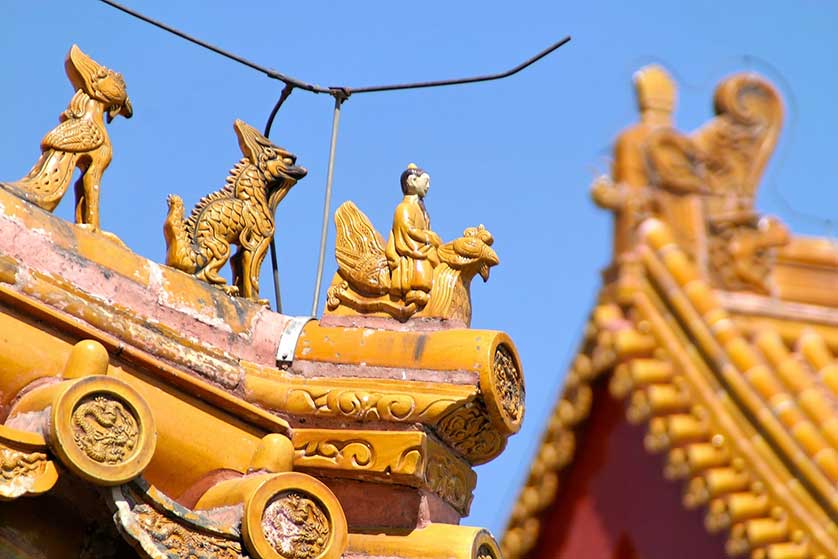
Something that unites most people who visit the Forbidden City (hear the pronunciation in Mandarin) is imagining what mysteries the still closed off sections hold, beyond view and unreachable to the public.
Everywhere, people look through gaps, between doors, over the tops of walls, behind screens or beyond a cordon. What they see in their stolen glimpse, is a faded dreamscape, much of it unrestored. Beautiful old temples, palaces so extravagant and delicate they are closed for their own protection and mysterious gardens whose paths are now only walked by museum staff.
Around one third of the Forbidden City is open to the public. Huge areas, courtyards, halls, temples, towers, libraries, walkways, pavilions, stables, hospitals, offices and gardens remain inaccessible and forbidden. This is a guide to those areas, a guide to places you cannot visit.

With your imagination and a stolen peak through a locked doorway, or glimpse of a distant tower or crumbling rooftop, you can visit the Forbidden City as it stands untouched by conservators and restorers. Its embattled face bearing the scars of a bloody and majestic history, the decadent and ornate setting of Imperial China's end.
The buildings described in this guide can be seen by following the brief instructions to vantage points where you can look over a wall, through a gap or over a rooftop. As you begin to realise how much of the city is off limits you will be able to gain a sense of how labyrinthine and expansive the place truly is and how intriguing its history can be. Even with only one third of the city open, it still has the power to overwhelm.
This guide does not encourage you to stray from the set tourist routes, you cannot visit any of the places in this guide. Use your eyes and imagination instead.
Palace of Continuing Happiness
Visible over the eastern wall of the courtyard in front of the Hall of Great Benevolence.
This intriguing structure was never completed and is a remnant of a time when the Imperial China was heavily influenced by the west. Built in 1909 by the empress dowager Long Yu, it is in fact the only western style structure in the Forbidden City.
According to Qing chronicles the palace stood in the centre of a water world, the walls and windows were set with glass panels, the floors were also made of glass and held up by a complicated bronze structure.
The empress could sit here literally surrounded by aquatic life, reeds swaying in the current, fish gliding and darting under their feet and through the walls.
The Western Garden and Destroyed Treasuries

Go to the north west corner of the Hall of Everlasting Spring and look over the wall towards the north west, you can see the crumbling rooftops of these buildings.
The western garden was built during the reign of Qian Long in 1740 after he discovered how cool and pleasant it was in that area during the summer, surrounded as it was by high walls. The garden he built was unusual, high mansions clung to the walls; it had an asymmetrical layout and winding paths and grottoes, secluded and peaceful.
Nearby were three ornate buildings which became store houses after Jia Qing ordered they be filled with his late father, Qian Long's favourite treasures. They were packed full of gold statues and Buddhist paraphernalia, Ming imperial portraits and rare curios. There they waited, hidden in the absence of their imperial owner for 123 years until in 1922 the deposed emperor Pu Yi decided he wanted an inventory of all the treasures stored there. During this confused and hurried time, while the treasures were being unpacked and a list made, the area caught fire.
According to the record, all the rare items stored there were lost, burned and the unique garden destroyed. In the fire several priceless treasures were lost including several thousand Tibetan sutra blocks carved in the mid 15th century, 1,000 gold Buddhist statues, and gold musical instruments used for the services, several oil portraits of various emperors and a golden pagoda in the Hall of Justice and Rectitude which stood over 16ft tall and contained over half a ton of gold built in the late 17th century.


Palace of Motherly Tranquillity
This palace complex can be seen through the Gate of Flourishing Posterity, from the cafe here you can see over towards the west where at the time of writing, the palace was being restored.
This palace was the residence of the empress dowager, mother of the emperor. Here she resided, received visitors and official ceremonies concerning her were held here.
For the 60th birthday of Qian Long's mother, a huge celebration was held in this building. Seated in the central hall, the empress dowager received her son, The Emperor and many courtiers and ministers who all bowed before her nine times and knelt before her three times.
The climax was reached when The Emperor began a traditional dance and soon accompanied by the princess and other male family members, danced happily to and with abandon. The celebration lasted five days and by the end of it she had received several Buddha statues, clothing, jewellery, gold, jade, ivory, agate and other gems.
The empress dowager enjoyed the height of luxury and etiquette in this building. Every year she was given 1kg of gold, 100kg of silver, 160 bolts of silk, 124 pieces of mink and beaver fur, everyday she was allowed 25kg of meat, one pig and a sheep.
However for all this extravagance these elderly women lived dull and monotonous lives, they had very little to do and filled their time by endlessly wafting between the several shrines that were built in the complex, using their final years to pray for peace and comfort in the next life. The sound of endless Buddhist sutras and clouds of ritual incense were always rising from this extravagant building.

Pavilion of Raining Flowers
This Pavilion is one of the most visible of the unreachable buildings, it can be seen from almost anywhere in the north western area of the city. It is surmounted by a tall tower whose eaves are fiercely guarded by four large golden dragons. The closest viewing place is from the narrow western-most passageway leading from the courtyard of the Hall of Evolution to the Palace of Eternal Spring.
Constructed during the reign of Qian Long (1735-1799) this building was a Buddhist temple and study area where the emperor could read sutras. Services were often held here too and many valuable statues of the Buddha were arranged inside for worship.
Its name comes from the trees growing by its entrance which rain flowers when in blossom. The structure is quite unique in the city, with its long sloping eaves and green and blue roof tiles, its distinctive tower is a tantalising glimpse of what lies in the inaccessible areas of the city.
There are several Buddhist temples and pavilions inside the Forbidden City yet their purpose was not for imperial worship, no emperor worshipped the Buddha in the city. These extravagant and beautiful temples were built during the Qing dynasty when the emperors were attempting to keep the distant Mongolian and Tibetan kingdoms under their control. They represent a political tool to pacify breakaway regions.
The Qing emperors also built many temples outside the city for the worship of the local people. Lamaism and in particular the Yellow Sect which was at that time, the state religion became an integral part of Chinese culture.
Archery Range

This building is now a tourist information office and is located at the southern side of the courtyard south of the Hall of Ancestral Worship.
The archery pavilion stands overlooking the archery range, now an open area sparsely wooded in imitation of a forest. It was used by the emperor and his sons to practice archery and equestrian skills, examinations were also held here. Birds and animals were released into the archery range and were shot at from the pavilion or hunted down on horseback.
The building reflects a tension in the cultural development of Imperial China. Qian Long built the pavilion in 1647 as a way of ensuring the warlike Manchu culture, which was the original culture of the Qing, was upheld in the face of the more refined and comfortable lifestyle of the Han who were the people of the north.
The Han influence was variously resisted by Qing emperors who sporadically attempted to reinstate the Manchu way of war. The archery range and the Hall of Military Eminence attest to this.
Pavilion of the Source of Literature
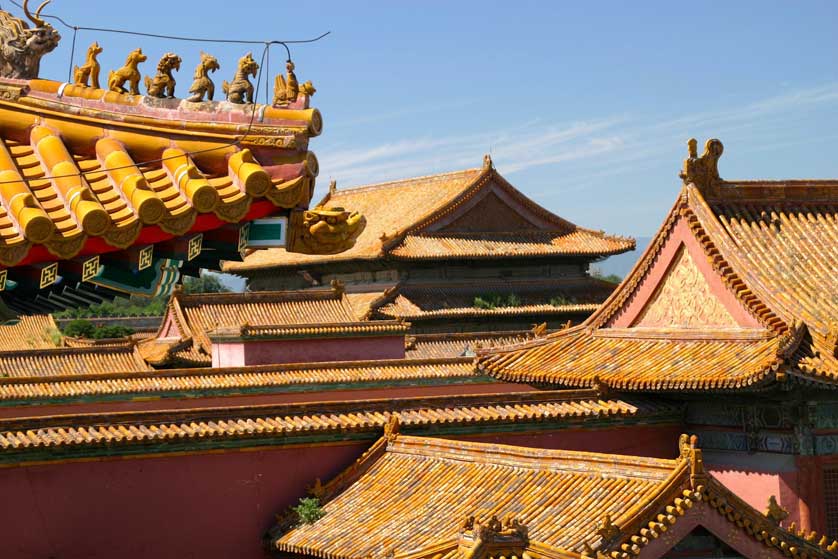
This building can be seen from the archery pavilion, when looking south, it is the large building with the dark roof and grey walls standing at the far end of the archery range.
Imperial Library of the Forbidden City
This is the imperial library of the Forbidden City and was built in 1774. Ancient books and scrolls were kept here including the legendary Siku Quanshu, an ancient encyclopedia known as the complete library of the four treasures of knowledge, one of the greatest literary works in world history.
It was an amalgamation of 10,000 manuscripts overseen by an editorial board of 361 scholars who finalised the first copy of the encyclopedia in 1782. It was bound in 36,381 volumes. Subsequently, an army of 3,826 copyists produced six more handwritten copies. Four were given to the emperor; one of these was placed in the Forbidden City library, three copies were made public.
Over time most of these works were burned, lost or deliberately destroyed until on of the final surviving copies was that inside the Forbidden City library. There it remained until, as the communist armies advanced on Beijing in 1949, the fleeing Kuomintang Nationalists fled with the books and many treasures to Taiwan where it and many amazing relics are held at the National Palace Museum in Taipei.
This building is one of the few with black glazed roof tiles. According to the five element theory, the colour black represents water, the subduer of fire, and so in order to protect the priceless books inside its walls, the roof was adorned in this colour.
Read more on the Forbidden City
Forbidden City Map
Book Hotel Accommodation in Beijing Near The Forbidden City
Book Hotels in Beijing - Booking.com
Find Hotels in Beijing - Agoda
Search Hotels in China - Booking.com
Recommended Hotels in Shanghai China - Agoda
Budget Hotels in Beijing - Booking.com
Best Hotels in Sanlitun - Booking.com
Book Luxury Hotels in Beijing
Beijing Palace Museum Ticket (The Forbidden City)
Mutianyu Great Wall Ticket & Cable Car