Nomad's Land: A Qinghai travelogue 青海
Daniel Allen
History has a curious way of repeating itself. Strategically located on a northern branch of the Silk Road, Xining - capital of western China's Qinghai Province - once hosted caravans fat with tea, timber and salt. Today, as a gleaming taxi whisks me downtown from the city's new suburban airport, jetlagged eyes take in a place alive again with burgeoning commerce.


En route to the recently opened Sofitel Xining, we pass serried ranks of pristine tower blocks, planted like supersized dominoes on the dusty earth. Ubiquitous flashing neon and rushing traffic give central neighbourhoods a sense of restless urgency. Adjusting to China's shifting economic reality, this is a city following in the distant wake of Shanghai and Beijing, both more than a thousand miles to the east.
Yet however much Xining, and the vast open spaces of Qinghai beyond, have both eyes on the future, this is a province with its feet firmly rooted in the past. Dig beneath the surface and visitors soon discover a place light years from Beijing, Shanghai and the whole of eastern China - ethnically, culturally and historically.
The place known today as Qinghai remains a frontier, a place of transition between contrasting ways of life, civilizations and landscapes. It is these contrasts that make this one of China's most enthralling provinces.


Into the Wild West
Leaving Xining the following morning, the air is crisp and the sky blue. Our minibus negotiates heavy early morning traffic, pulling over once beside a roadside stall to stock up on outsized water melons. A series of mosques punctuate the city's high-rise skyline, their squat onion domes nestling incongruously below concrete apartment blocks and shiny skyscrapers.
Inhabited by over 40 ethnic groups, Qinghai is one of China's most cosmopolitan regions. In Xining, it is the Hui - a Muslim minority descended form Arabic and Persian merchants - who are most noticeable, with their mosques and markets and spotless white taqiyah. Beyond the city limits, however, the province's diverse ethnicity paints a very different picture.
We soon leave the outskirts of Xining behind, passing through fields of barley and bright yellow rapeseed. Rectangular mud-brick houses begin to appear, the corners of their flat roofs decorated with fluttering flags. In the distance, snow-flecked mountain chains extend toward the horizon, their peaks obscured by miniature eiderdowns of cloud.
Situated in the north-east corner of Qinghai, Xining sits at the very edge of the Qinghai-Tibet Plateau. The so-called "roof of the world", this vast, high-altitude region of arid steppe, winding glaciers, verdant grassland and brackish lakes is the source of China's mightiest rivers - the Yellow and the Yangtze. Yet head west from Xining, and it is Tibetan culture, not Han Chinese or Hui, which increasingly predominates.
As our bus approaches the town of Gangchang, close to the shoreline of Qinghai Lake, Buddhist temples and stupas adorn the tops of nearby hills. Long streams of prayer flags stretch across the road in a fluttering kaleidoscope of colour, while weatherworn men with braided hair stare up at us from the back of wooden carts. Less than 120 miles from Xining, it already feels like we're entering another world.

Prelude to a Pearl
When Qinghai was officially created in 1928, it incorporated much of the former Tibetan region of Amdo, itself a loosely ruled area inhabited by farmers and nomads. Today there are still close to a million Amdo Tibetans living in Qinghai, representing one in four of the population. Large-scale social engineering has seen an increasing number resettled, but many Tibetan drokpa - or "high pasture people" - still enjoy a close and vital bond with the land.
Sitting at an altitude of 3,200 metres (10,500 feet) the area around Qinghai Lake boasts some of the finest grassland in China. Beyond Gangchang we begin to pass herds of shaggy-coated yak and sheep grazing beside the road, many with colourful ribbons in their tails. Clusters of drokpa tents, each made from black yak wool or white cotton canvas, dot the undulating landscape, the finest with Tibetan motifs on all four billowing sides.
Pulling over to investigate one particularly photogenic yak herd, a Tibetan woman in a pink head scarf beckons me inside her tent. Inside everything is clean and simple; a stove sits in the middle, fuelled by dried yak dung and surrounded by pots of barley flour and yak butter. Beautifully painted wooden chests line the walls, while yak-hair bags dangle from the ceiling. Framed by the open doorway, a bright green sea of grass stretches toward the distant, snow-capped wall of the Qilian Mountains.
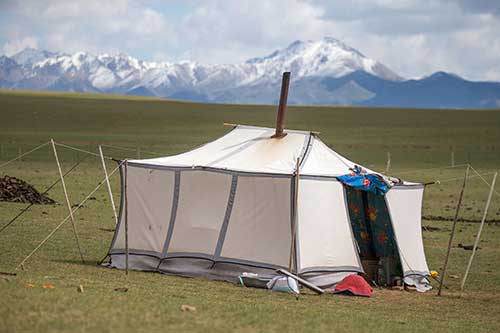
Much as I'd like to stay, visiting time is sadly limited. After a welcome glass of sweet black tea, I shake hands with my host, handing over some unwanted medicine in a parting gift. The air outside the tent is filled with the high, tinkling chorus of airborne skylarks, while the sound of human cries and yak bells carries faintly on the breeze. Life is undeniably harsh for many of Qinghai's dropka. Yet today, surrounded by the blooming beauty of summer, it's not hard to see the appeal of their wandering existence.
With its wild and remote spaces, Qinghai is unsurprisingly home to some of China's most precious flora and fauna. Snow leopards roam the high mountains of the south, while the highly endangered Przewalski's gazelle, a small antelope, still survives in pockets around Qinghai Lake, clinging on in the face of encroaching civilization.

Nikolai Przewalski, a 19th century Russian military explorer, has also lent his name to another endemic Qinghai Lake species - the curious Gymnocypris przewalskii, or naked carp, known locally in China as the huangyu, or "golden fish". Overfished for decades, this scaleless fish was once on the verge of extinction, threatening local livelihoods and bird populations. Now, thanks to an artificial breeding programme, it's making a comeback.
The success of this programme is evident when we pull over beside a fast-flowing waterway, surrounded by crowds of Chinese tourists. Huge shoals of carp shimmer just below the surface, effortlessly swimming against the flow, before launching themselves up a shallow weir. It's heartening to see Chinese wildlife conservation, not something for which the country is particularly renowned, having a beneficial impact.
Holy Water
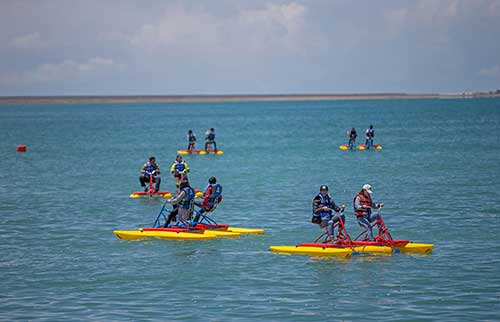
Known as Tso Ngonpo in Tibetan, Qinghai Lake is sacred to both Tibetan and Mongolian Buddhists, who regularly make pilgrimages to lake side temples and circumambulate the shoreline on their spiritual kora. Famed for its translucent waters, the so-called "pearl of Qinghai" extends over 1500 square miles, making it China's largest inland body of water and the largest salt lake in Asia.
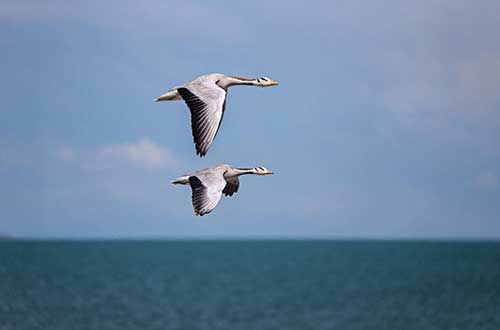
After a quick stop for lunch, the highlight of which is yak butter-fried ren shen guo (a local plant root), we drive on to Bird Island, a small islet at the western edge of the lake. The lake itself, now close to the road, sits like a vast turquoise pool, framed by a cloudless sky and the smudge of distant hills. Skeins of geese fly overhead, honking mournfully as they spiral down toward the water's edge.
An important stop on several avian migration routes, Qinghai Lake is famous for its transitory populations of birds. Situated on the lake's western shore, Bird Island (Niao Dao in Chinese) is an amazing spectacle in the summer months, as tens of thousands gather to breed.
It turns out that Bird Island is actually two islands - the appropriately, if not imaginatively named Egg and Cormorant Islands. The former is covered with bar-headed geese and their recently hatched goslings, continually clamouring for food in their down-lined nests. A remarkable bird, this species of goose has been seen flying over Mount Everest en route to wintering grounds in southern Asia.
The highlight of Cormorant Island is a dome-shaped rock carpeted with thousands of nesting cormorants, each squabbling for space on guano-covered cliffs and ledges. Beyond the rock the turquoise waters of the lake extend to the horizon, while an expanse of glowing yellow sand dunes is visible farther round the shoreline. Looking out over the water, a pair of shaven-headed Buddhist monks pose for pictures, their scarlet and yellow robes contrasting strikingly in the intense sunlight.
Crossing the high passes that dominate their land, Tibetans frequently shout "La Gyalo!" or "Victory to the Gods!", reflecting the sacred sense of landscape that is central to the animistic elements of Buddhist culture. Standing beside one of their holiest lakes, I wonder how these monks feel about man's deepening influence on the local environment. Playing around with their smart phone settings, today they don't seem too deeply troubled.
On Reflection: Chaka Salt Lake
Leaving Qinghai Lake, we drive on through the grassland in the direction of Chaka Salt Lake, another of Qinghai's natural marvels. A seemingly never ending succession of switchbacks eventually brings us to a pass at the top of Xiangpi Shan ("Rubber Mountain" in Chinese). At 3817 metres (12,500 feet) the air is thin and bitingly cold, while a rough pyramid of prayer flags flaps furiously in the stiff breeze.
As we pull over to admire the view, a Tibetan man in a leather hat wanders over to show me the contents of a metal box. Inside is his personal, precious haul of yarsagumba (literally "summer grass, winter insect" in Tibetan), a bizarre hybrid of caterpillar and fungus. Found in Himalayan alpine areas at around 4,000 metres, it is prized, especially in China, for its supposed aphrodisiac properties. Others believe it to be a biological panacea, curing everything from headaches to cancer.
Fetching up to £650 per kilogramme, the yarsagumba has become something of a cash cow for the Qinghai drokpa, with many heading to the mountains in May and June hoping to get rich quick on this elusive herbal viagra. I'm offered one piece for 200 RMB (£23), but plead poverty. Budget paracetamol will have to suffice on this trip.
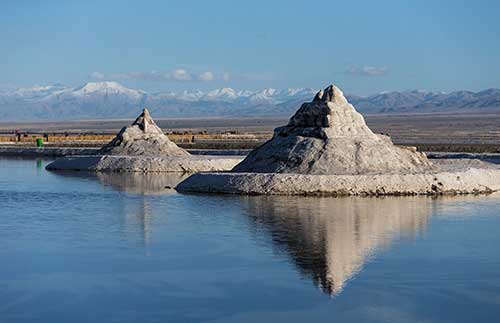
From the apex of Rubber Mountain the road drops down on to a flat, arid plain covered with tussocks of grass and the occasional homestead or drokpa tent. In June the distant mountains are still covered in snow, while at their base salt flats cover the ground with crystalline whiteness. High quality salt has been mined in this area for 3000 years, and ongoing production continues to supply much of China's needs.
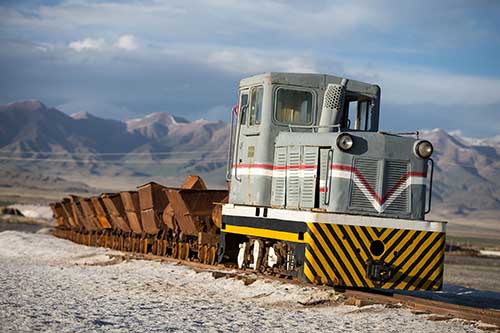
With the sun low on the horizon, we eventually arrive in the town of Chaka and the recently spruced up visitor centre at Chaka Lake. An increasingly Chinese popular tourist destination, the lake's shallow, hypersaline waters reflect everything with perfect clarity. A Han Chinese couple in full Western wedding regalia hurry past to catch the warm, late afternoon light, while Tibetan boys crowd around us selling protective plastic boots. As my first fascinating day in multi-ethnic Qinghai draws to a close, the cultural juxtaposition seems somehow appropriate.
Qinghai Essentials - Getting To Qinghai
- The Beijing-Lhasa train passes through Qinghai on the Qinghai–Tibet railway. The train to Xining departs from Beijing West Station.
- Xining Caojiabao Airport has connections with numerous Chinese cities including Beijing, Changsha, Chengdu, Dalian, Hangzhou, Hohhot, Hong Kong, Lhasa, Nanjing, Qingdao, Shanghai, Shenzhen, Urumqi, Xiamen, Xian and Wuhan as well as Bangkok.
Qinghai Accommodation
Book hotels in Qinghai
The Sebel Xi Ning Hotel
Qinghai Articles

Book Hotel Accommodation in Beijing China
Book Hotels in Beijing - Booking.com
Find Hotels in Beijing - Agoda
Search Hotels in China - Booking.com
Recommended Hotels in Shanghai China - Agoda
Budget Hotels in Beijing - Booking.com
Best Hotels in Sanlitun - Booking.com
Book Luxury Hotels in Beijing
Beijing Palace Museum Ticket (The Forbidden City)
Mutianyu Great Wall Ticket & Cable Car
Guide Books on Beijing & China